
Manufactured Sand Plants for Australian and New Zealand Quarries
Concrete sand made from the crusher dust a quarry already produces, rather than natural sand hauled in from further away each year.
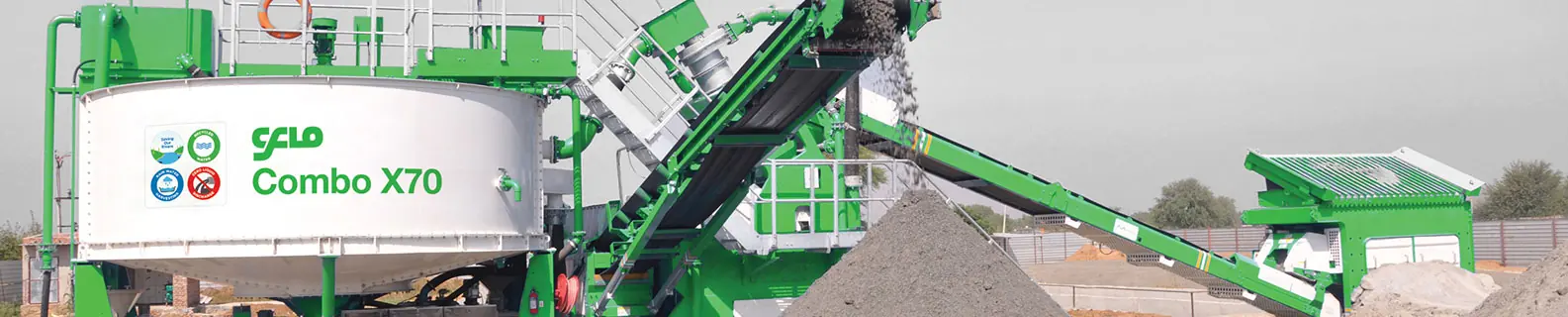
The Combo is a modular washing plant that turns crusher dust and crushed rock fines into washed concrete sand and clean graded aggregate, at up to 350 tonnes per hour on one chassis and more where units are combined. It removes the minus 63 micron fraction at a cut point set to the specification, recycles up to 95% of its process water and is engineered to AS/NZS requirements. In Australia it is supplied through a CFlo Certified Partner, with sales and support from CFlo Oceania for Australia and New Zealand and delivery managed by CFlo Europe Limited in Belfast.
The feed an Australian quarry already has
Every hard rock quarry produces sand-sized material as a by-product of crushing. The sub-5 mm fraction left when rock is crushed is called crusher dust or stone dust in Australia, and crushed rock fines or quarry fines in Britain and Ireland. The names describe the same material everywhere: too dusty and too poorly graded to sell as sand, so it stockpiles at the crusher or goes out as low-value fill.
Washing is what turns it into a product. A Combo takes the minus 63 micron fraction out, typically 15–20% of the feed, scrubs off any clay, and grades what is left into concrete sand. The lean 63–600 micron fraction, the range where crusher dust is most deficient and every particle counts, is kept in the product rather than lost with the fines.
The same chassis does the coarse end of the job as well. On a quarry with scalpings or reject stone, it scrubs, screens and rinses the silt and clay off the aggregate, so one plant can send a graded aggregate and a specification sand to the stockpile from a single feed.
Why the move to manufactured sand
Natural sand within economic haulage of the major eastern seaboard cities is becoming harder to find. Deposits close to the cities are worked out or constrained by planning and environmental approvals, and the deposits that replace them are further from where concrete is poured. Freight is charged by the tonne over every kilometre, so the delivered cost of natural sand rises each time the source moves further out.
Manufactured sand from crushed rock is the response. The hard rock quarries that already supply coarse aggregate to the cities produce crusher dust as a matter of course, from material that has already been drilled, blasted and crushed. Washing it into concrete sand produces the sand where the demand is, and the haulage avoided counts commercially before it counts environmentally.
The same arithmetic applies in New Zealand wherever consented natural sand is limited and hard rock is quarried close to the market.
The specification the sand has to meet
Washed sand off a Combo is made to sit inside a grading envelope, not simply to look clean. In Australia and New Zealand, concrete sand is sold against the national standards for concrete aggregate, and where the concrete goes into road and bridge works the state road authority specification applies as well, with its own requirements for grading, fines content and deleterious material.
The fine end is where a plant holds the specification or does not. The ultrafine fraction has to come out under control, at a cut point the operator sets, not wherever the water happens to take it. On a Combo the Screenmax FS86 high precision fines screen holds the top of the gradation and dewaters the product on the same deck, and the Vertimax upward flow classifier trims the excess fines that crusher dust always carries, bringing the sand inside the envelope rather than leaving it just outside.
Wing stockpiling conveyors controlled by a hydraulic cylinder let one plant send two sand products to two stockpiles at once, so a quarry can sell a concrete sand and a finer plaster or masonry sand from the same feed. The Centriscreen dewatering and sizing system delivers both ready for market straight from the belts.
Clause-by-clause compliance is a matter for the Sample Study, which reports the washed sand against the specification your customer actually names, using that standard's own test methods, so the result can be read directly against what the sand will be sold on.
The Combo in figures
Nine models cover the range up to 350 tonnes per hour on a single chassis, and capacity beyond that comes from combining units rather than moving to a larger machine. The X series is single wash; the Alpha, Turbo, Multi and Mega are dual wash. Each plant is custom built for its feed, so the scrubbing intensity, the cut points and the dewatering are set by the material rather than by a catalogue.
| Model | Throughput | Wash |
|---|---|---|
| Combo X50 | 45 to 50 tph | Single |
| Combo X70 | 70 to 100 tph | Single |
| Combo Turbo D90 | 80 to 90 tph | Dual |
| Combo Alpha | 100 to 120 tph | Dual |
| Combo Multi E5 | 100 to 200 tph | Dual |
| Combo X120 | 120 to 140 tph | Single |
| Combo X150 | 150 to 180 tph | Single |
| Combo X220 | 220 to 250 tph | Single |
| Combo Mega E5 | 200 to 350 tph | Dual |
Standard capacity varies with feed gradation, clay content and moisture, which is why sizing follows a sample rather than a table.
All seven functions of wet processing sit on the one patented chassis: feeding, screening, classification, dewatering, water recovery, sludge handling and stockpiling. The plant ships in standard containers, lands on simple pads without anchoring and runs at under 80 dB. The control panel is built by CFlo as an accredited panel builder, housed in a double door stainless steel enclosure for harsh outdoor conditions, with a touch screen PLC as standard. Walkways are to the same specification as a static plant. CFlo holds patents in Australia covering the Combo, and plants for Australia and New Zealand are engineered to AS/NZS requirements.
Water: up to 95% recycled
The Combo recycles up to 95% of its process water on the same chassis, and the installation runs with zero liquid discharge. On an Australian quarry that bears on water licensing, on what a settling pond costs in land you could otherwise be quarrying, and on whether the plant keeps running through a dry year.
The Hydromax thickener recovers the water and the Easysettle sludge bay manager rigidifies the tailings at the point of disposal, using high performance polymer technology to release water from the treated slurry immediately. Tailings dry faster, the pond footprint shrinks and recycled water is back in the plant sooner. Both are built into every CFlo plant as standard. Where a site has no room for ponds at all, mechanical dewatering can be specified instead.
A fleet of eleven, moved between highway packages
GR Infraprojects, a listed Indian EPC company with about $880 million of annual revenue, runs a fleet of eleven Combo plants across its highway projects. It took its first unit in 2017, five more in 2017 and 2018, and another five in the years that followed. On the 701 km Samruddhi Mahamarg Expressway in Maharashtra, contractors ran more than a dozen Combo plants and nearly 45% of the expressway used sand produced by them.
Each plant is relocated between packages in about ten days from shutdown to on-specification production at the next site. Disassembly, packing and loading take about three days, and because the water recycling system is self-standing on the same chassis there are no heavy thickener foundations to leave behind. The washed sand is IS 383 compliant, the Indian concrete aggregate standard, and the specification holds as the plant moves.
"M sand made from crusher dust using CFlo is superior to natural sand. Results are better. We save 20–25 kg of cement in M45 concrete. In Maharashtra natural sand costs about Rs 2,000 per tonne; CFlo sand costs about Rs 550 per tonne."
The GR Infraprojects case study has the relocation checklist and the operating detail. Dilip Buildcon operates more than a dozen Combos and attaches one to each of its crusher installations, and YTL Cement in Malaysia runs two Combo X70 plants at its Batu Tiga Quarry converting 0–5 mm crusher dust into graded manufactured sand. See also manufactured sand.
The same duty at 80 million tonnes a year
Limestone scalpings are the same problem a hard rock quarry in Australia has, and the Combo has been ordered for it at the largest scale in the Middle East. Stevin Rock, wholly owned by the Government of Ras Al Khaimah and operating there since 1975, produces more than 80 million tonnes a year across three sites, from limestone, dolomite and gabbro reserves of over 4.5 billion tonnes. Its Khor Khuwair quarry alone has a capacity above 60 million tonnes a year.
Stevin Rock has taken a Combo Mega E5 to wash limestone scalpings and mine rejects into washed, graded product. The CE certified plant has been dispatched, commissioning lies ahead, and CFlo will publish the measured results once the plant is running rather than before. The project announcement has the detail.
It is not a first attempt at the application. Power International, a Bathwal Group company, already runs a Combo Mega E5 at its Fujairah limestone mine, turning minus 10 mm rejects into construction sand and recovering the 5–10 mm fraction as low silica limestone, with 95% of the water recycled. That installation is documented in the Power International case study.
Where the feed is dry, the dry route
Washing is the route when crusher dust carries clay, because clay has to be scrubbed off and only water does that. There is a narrower case where water is not needed at all.
Where sand comes straight off the crushing plant through a closed circuit it arrives dry, and the only thing wrong with it is too much ultrafine material. An Aerograder takes those fines out in air: no process water, no settling ponds, no tailings and no screen media to blind or replace. Hotmix asphalt plants are the clearest case, because bituminous mixes will not tolerate a high ultrafine content and those plants usually sit alongside the crusher already.
The feed specification is dry and clean: below 5 mm and under 2% surface moisture. An enclosed crusher-to-classifier circuit or an arid site gives year-round dry feed. What comes back depends on the rock and on what the crushing circuit sends across: at Samruddhi Mahamarg, Afcons produced a consistent graded manufactured sand this way, and on other rock types the result is a measurable reduction in ultrafines rather than a certified grade. Where the dust is wet or carries clay, the Combo is the plant. The two are complementary rather than competing, and the Sample Study establishes which applies to your material.
Already in manufacture for Australia
CFlo's first frac sand project in Australia is a Micrograder rated at 80 to 100 tonnes per hour, in manufacture for a site near Darwin in the Northern Territory, with commissioning scheduled for early 2027. It will wash and classify local sand into proppant grades for a large oil and gas operator, replacing sand that has been hauled in by road from more than a thousand kilometres away. It is being delivered through a CFlo Certified Partner in Australia.
The plant recycles around 95% of its process water, runs with zero liquid discharge, is built to Australian and New Zealand standards and ships as containerised modules, so commissioning on site is measured in days rather than months. Ryan Barker, Regional Head of Operations and Delivery at CFlo Europe Limited, is managing delivery. The project announcement sets out what the plant has to hold.
Proppant is a different product from concrete sand, but the delivery route is the one a quarry would use: a containerised modular plant, engineered to AS/NZS requirements, supplied through a Certified Partner and delivered by the Belfast team.
Sizing it: the Sample Study route
Sizing starts with a sample. Feed gradation, clay content and moisture decide the configuration, so material is piloted at CFlo's DSIR-accredited Sample Study & Interpretation facility before anything is specified. The lab runs pilot units on bulk samples rather than bench tests, and the washed sand is tested in concrete, so what comes back is a product result rather than a process result.
The first conversation is about how to take a representative sample, because that matters as much as how much you send. The sample travels to the CFlo works at Sankrail Industrial Park, Howrah, with the paperwork agreed beforehand. Testwork runs in sequence, each stage chosen on the evidence of the last, and the report gives the mass balance, grades, yields, consumption figures, a recommended flowsheet and samples of the products. Where the sand is sold against an industry standard, the testwork follows that standard's own test methods.
Pre-Engineering follows if the numbers work. While your financial clearance is still in progress the plant is designed in full: process flow, mass balance, layout and equipment schedule, over twelve weeks in four phases, with long-lead items identified and vendors pre-engaged during the engagement. Manufacture starts the day the supply contract is placed rather than beginning from a blank sheet.
Send us a sample
Tell us about the material and an engineer will come back with how much to send, how to sample it, and what the programme would cover.
Who you deal with in Australia and New Zealand
CFlo sells through Certified Partners, who supply the plant to the quarry. The Darwin plant is being delivered through a CFlo Certified Partner in Australia, and a construction sand plant follows the same route. CFlo Oceania provides sales and support for Australia and New Zealand on +61 870 925 996 and [email protected].
Oceania sits in the same territory as the UK and Europe, so the engineers delivering the Darwin project from Belfast are the engineers who would deliver yours. Aggregates Business set out the partner-led model behind the expansion in a feature in August 2026.

A career spent building wet processing plant for quarries in Britain and Ireland, having previously helped build a global wet processing brand.


What we need from you to start a Sample Study
A sample or a recent gradation of the crusher dust, its clay and silt content, the moisture as it arrives, the tonnes per hour you want to put through, and the specification the sand has to meet, including which state road authority specification applies if the concrete goes into road works. If you already sell crusher dust, the price you get for it is useful too, because it is the number the washed sand has to beat.
Start with the Sample Study, or contact CFlo Oceania and the team will scope the programme with you and your Certified Partner.
Frequently asked questions
Can the Combo make concrete sand from crusher dust to Australian and New Zealand specifications?
That is the duty it is most often bought for. The plant scrubs and washes the dust the crusher produces, removes the minus 63 micron fraction under control and grades what is left to sit inside a concrete sand envelope. Whether a given feed gets fully inside the national standard and the state road authority specification your customer names depends on the rock and the crusher setting, which is what the Sample Study establishes before any plant is specified.
How much of our crusher dust becomes saleable sand?
Typically the minus 63 micron fraction, around 15–20% of the feed, has to come out; most of the rest can become washed concrete sand. The lean 63–600 micron fraction is kept in full. The exact recovery depends on your dust, which is why the Sample Study quantifies the commercially viable product before the plant is designed.
How much water does it use, and do we need settling ponds?
Up to 95% of the process water is recycled and the installation runs with zero liquid discharge. Tailings are handled by the Easysettle sludge bay manager, which releases water from the slurry at the point of disposal so ponds dry faster and take less land. Where a site has no room for ponds, mechanical dewatering can be specified instead.
Can the plant be moved to another quarry?
Yes. All seven wet processing functions sit on one chassis, including the water recycling system, so the plant ships in standard containers and lands on simple pads without anchoring. GR Infraprojects relocates its Combos between highway packages in about ten days from shutdown to on-specification production at the next site.
Is a dry classifier an option instead of washing?
Only where the feed is dry and clean: below 5 mm and under 2% surface moisture, which an enclosed crusher-to-classifier circuit or an arid site gives year-round. On that feed an Aerograder removes excess ultrafines in air with no process water or tailings, and hotmix asphalt plants alongside a crusher are the clearest case. Where the dust is wet or carries clay, washing on a Combo is the route.
Who supplies and supports the Combo in Australia and New Zealand?
CFlo Certified Partners supply the plant, with CFlo Oceania providing sales and support for Australia and New Zealand on +61 870 925 996 or [email protected], and delivery managed by CFlo Europe Limited in Belfast. Plants are engineered to AS/NZS requirements. Begin with the Sample Study or contact us.