
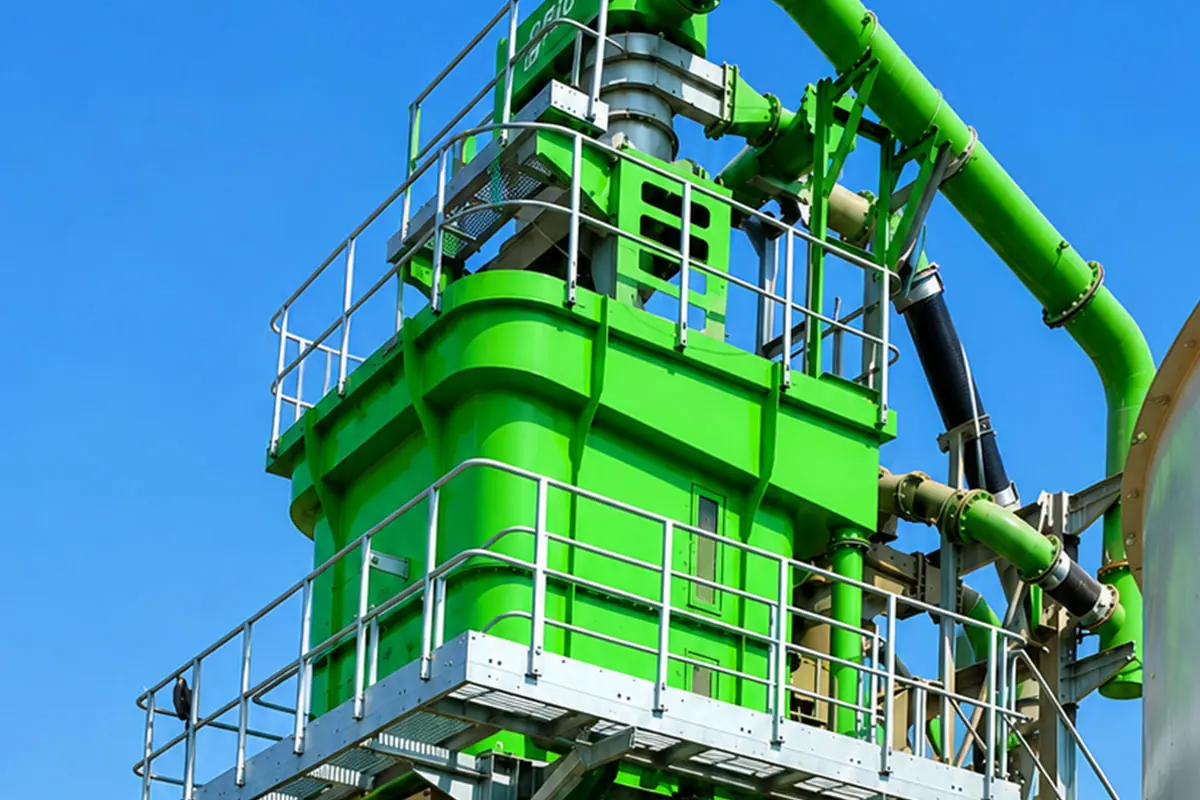
Vertimax Upward Flow Classifier
The mid-range sand cut no screen or cyclone can make, held automatically hour after hour.
The CFlo Vertimax is a fully automated upward flow classifier. Rising water fluidises a bed of sand so that particles sort themselves by settling velocity, giving a sharp and adjustable cut in the fine sand range where screens blind and cyclones scatter. It also separates by density, floating lignite, organics and light contaminants off the top. The cut point is a PLC setpoint, changed in minutes without touching the machine.
The separation nobody else makes
Every fine sand plant has three parts of the gradation to control, and they are not controlled by the same machine.
Screens fix the top. Hydrocyclones fix the bottom. The middle, roughly 150 to 300 microns, belongs to neither: a screen blinds at those apertures and a cyclone bypasses and scatters too widely to hold a band. That middle cut is exactly where a specification sand is won or lost, because getting it wrong puts both products either side of it out of specification at once.
The Vertimax exists for that cut.
Industries this plant serves
How a teeter bed works
Water is injected through pipes across the base of the tank and rises through the material. The upward velocity is highest at the bottom and falls towards the top.
A falling particle accelerates until the upward current matches its settling velocity, and there it stops: the bed is held in a state of teeter. Coarse particles pack towards the bottom, where high-velocity water threads through the gaps between them. Fine particles stay in open suspension near the top and leave over the overflow launder. Particles constantly migrate along the path of least resistance and are replaced by others, so the bed is a live sorting medium rather than a static filter.
Because the sorting is by settling velocity rather than by aperture, nothing blinds and nothing wears out making the cut.
It separates by density too
Settling velocity depends on density as well as size, which gives the Vertimax a second use that a screen cannot offer at all.
Where the feed contains particles of genuinely different specific gravity, the heavy material settles and builds up in the tank while the light material reports over the top. Lignite, coal specks, plastics and organic matter float off and leave the sand behind. In glass sand that protects batch purity; in recycled aggregate it lifts trash out of the stream; in a multi-sand plant it means two graded sands and a lignite reject from one machine.
The cut point is a setpoint
This is what makes the machine practical in service.
A pressure transmitter near the base measures bed inventory continuously and reports it as a percentage, which is far more reliable than reading a sight window. A PLC compares that against the target and modulates pneumatic pinch valves on the underflow to hold it.
A denser, fuller bed raises the effective cut size. A leaner bed lowers and sharpens it. So changing the product grading means changing one number on the HMI: no mechanical adjustment, no spigot or vortex finder swap, no downtime. In our own testwork the same machine was moved from a roughly 300 micron cut to the finer frac sand cut purely by changing the bed level target.
Once set, the loop holds it. The classifier runs unattended and the cut does not drift with feed variation, which is the whole point when the product is sold against a sieve specification.
Built for abrasive duty
The classification tank is square-section and fully rubber lined, because fine silica moving at velocity is relentless and there is no economic case for making the vessel out of something that wears.
There are no moving parts inside the tank at all. The work is done by water, so there is no impeller, no flight and no bearing immersed in the slurry. Teeter water enters through evenly distributed spray nozzles fed from a rear manifold, pointed against the material flow, with a manifold gauge for local verification and flushing lines to clear blockages.
The water supply has its own dedicated pump, flow meter and motorised control valve, so teeter flow stays stable regardless of what the rest of the plant is doing. That independence matters: the separation is set by upward water velocity, so a supply that sags when another pump starts is a separation that moves.
A deck-mounted feed cyclone densifies the feed and drops it centrally into the column, keeping the whole assembly in one compact tower.
Where it fits in the circuit
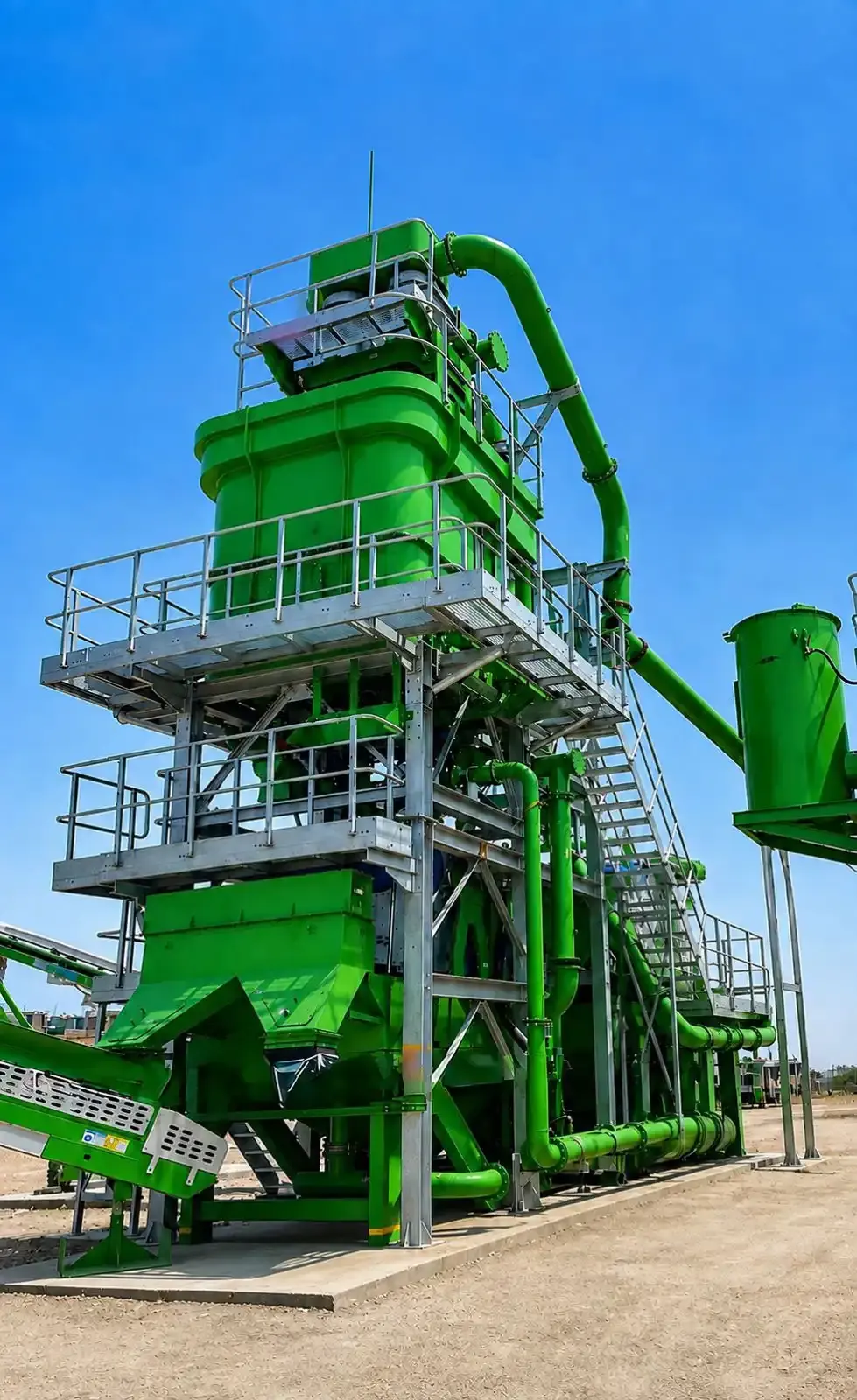
The Vertimax is a standard part of CFlo Micrograder industrial sand plants, working alongside the Screenmax FS86 High Precision Fines Screens that hold the top of the gradation and the cyclones that hold the bottom. It is also supplied on its own.
Typical applications are frac sand and proppant, where tight sieve bands decide whether the product is saleable; silica and glass sand, for grading and for floating organics out of the batch; foundry sand graded to AFS; manufactured sand, trimming excess fines into the concrete grading envelope; beach sand and sea sand; and C&D waste recycling, recovering clean saleable sand and lifting light trash out of it.
Model range
| Parameter | Vertimax 30 | Vertimax 70 | Vertimax 200 |
|---|---|---|---|
| Production (tph) | 20 | 50 | 120 |
| Power (kW) | 7.5 | 22 | 30 |
| Teeter water (m³/hr) | 30 | 70 | 200 |
Each model is named for its teeter water requirement in m³/hr, which makes for the fastest sizing check in the field. All three share the same control system and wear package. The real selection is made by CFlo engineering from your feed particle size distribution and target cut, and confirmed by testwork rather than assumed.
Frequently asked questions
What is an upward flow classifier?
A tank in which rising water holds a bed of material in suspension so that particles separate by settling velocity. Coarse and heavy material sinks to the underflow, fine and light material leaves over the overflow. It is also called a teeter bed separator or hydrosiser.
Why not just use a hydrocyclone?
A cyclone is excellent at the bottom of the gradation and cheap to run, but its cut has a wide bypass and it scatters, so it cannot hold a narrow band in the mid-range. Changing its cut means changing hardware. Most fine sand plants use both: cyclones for desliming, a Vertimax for the precise mid-range split.
Can it remove lignite and organics?
Yes, and it is one of the main reasons to specify one. Light contaminants have a low settling velocity, so they report to the overflow and leave the sand behind. In a multi-sand plant that can mean two in-specification sands and a lignite reject out of one machine.
How is the cut point changed?
From the plant HMI. The bed level target is a number in the PLC, and the control loop holds the new value through the discharge valves. There is no mechanical change and no downtime.
Does it need much attention once running?
No. Closed-loop bed control is what the machine is for. The instruments to watch are teeter water flow and manifold pressure, and the bed level reading itself, all of which are on the HMI.
Will it work on my sand?
That is a question for testwork rather than a catalogue. Send a representative sample and we run it: feed characterised, the unit configured to your target cut, and the streams sampled and analysed so you see the partition on your own material before a machine is specified. Sizing and commissioning setpoints then come from that data.