
Sample Study & Interpretation and Pre-Engineering
Study your material and engineer the plant before you place the order.
CFlo provides two services in sequence. A Sample Study establishes how your material behaves, through bench-scale and pilot-scale work on bulk samples, with chemical assay and testing of the finished product in concrete and brick, and our engineers interpret what that behaviour means for your project. Pre-Engineering then turns those results into a complete engineering package, so manufacture can begin as soon as the project is cleared rather than after a further twelve weeks of design.
The only question that matters before you buy
Every capital equipment decision in this industry comes down to one unknown: what will my material actually do? Deposits vary within a single pit. Two quarries crushing the same rock produce dust that behaves differently. A tailings dam is not uniform from one end to the other.
A supplier can show you what a machine does on another operator's feed. That tells you the machine works. It does not tell you what your deposit will yield, at what grade, at what water and polymer consumption, or whether the product will sell.
The facility exists to remove that gap. You send material; we study it; the design that follows carries numbers from your sample rather than from a catalogue.
What makes this different from a laboratory
A laboratory tells you what your material contains. This tells you what a plant will produce from it, and then designs that plant.
Pilot units, not jar tests
Most laboratories in this field work at bench scale, which characterises a material but no more. Scaling up from a jar to a plant remains an estimate.
The facility runs pilot-scale as well as bench-scale equipment, configured as a circuit rather than as isolated experiments. The result is a mass balance across the whole flowsheet at meaningful feed rates, including the interactions between stages, since in a working plant the performance of one stage determines what the next has to handle. A report states the recovery, grade, water and polymer consumption to expect, rather than that the material should respond to a given treatment and our engineers set out what that means for the plant you are considering.
What is in the facility
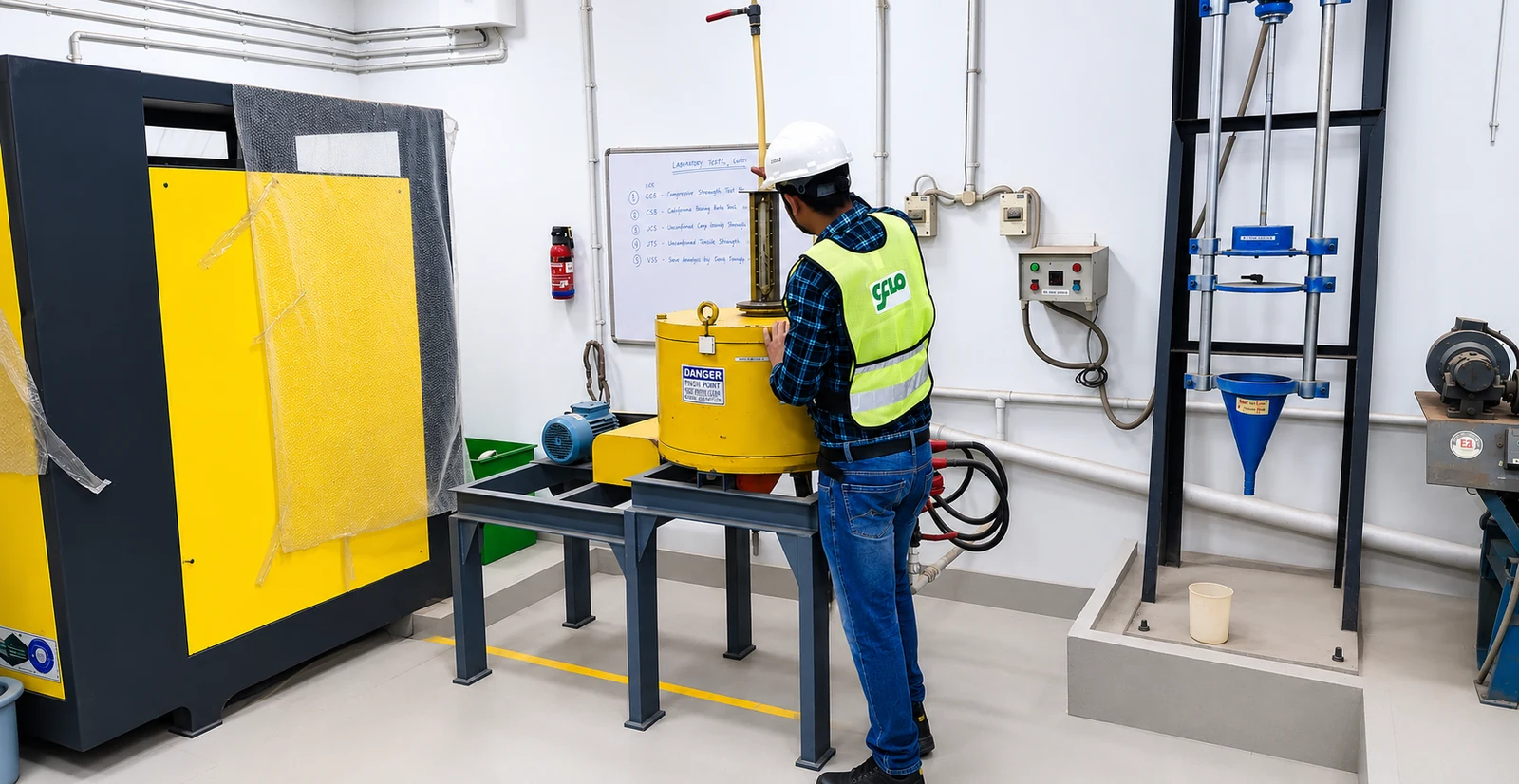
The facility is equipped as a mineral processing plant at pilot scale, so a sample can be taken through the same unit operations it would meet in production.
Mineral processing and classification
- Counter flow classifier
- Pulsator jig
- Spiral gravity concentrator
- Wet high-intensity magnetic separator
- Attrition cell, log washer and drum scrubber
- Hydrocyclones
Slurry and wastewater treatment
- Slurry pump test rig
- Filter press
Particle size and crushing
- Dry and wet sieve shakers
- Jaw crusher
Construction material testing
- Brick-making press
- Compression testing machine
Chemical analysis
- On-site testing for mineral composition, by wet process and spectrophotometer
What a study covers
A study is assembled from the stages your material needs rather than run as a fixed list.
Optional studies may or may not be undertaken, depending on the findings of the preceding work. They will be pursued only where the initial observations warrant it.
How a study runs
Where a product is sold against an industry standard, the study follows that standard's own test methods, so the result can be read against the specification the material will be sold on.
The people
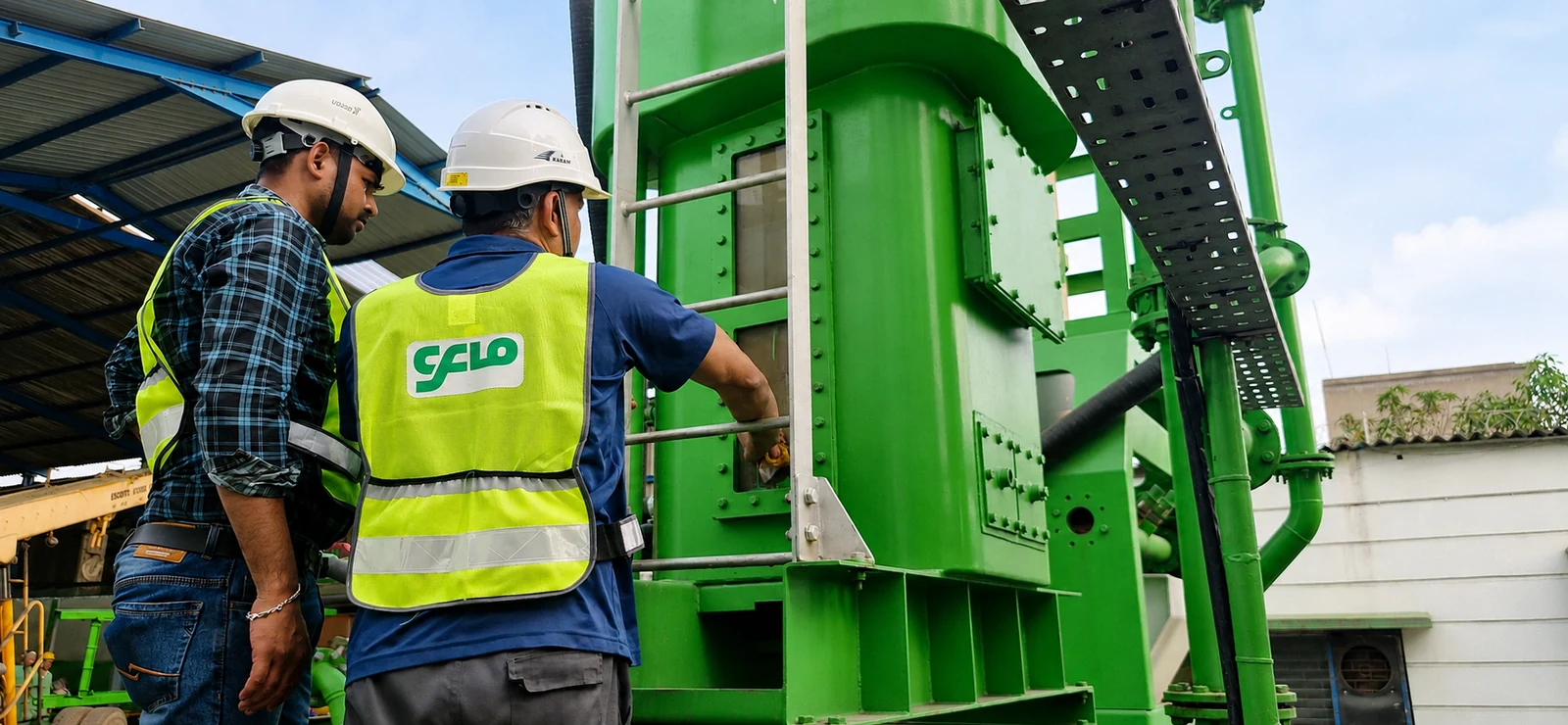
A pilot plant produces data. Interpreting it takes people who have seen a great many ore bodies and know which anomalies matter. That interpretation is the service.

Technical leadership sits with Dr Arabinda Bandyopadhyay, CFlo's Chief Technologist, who brings over forty years in process development and technological innovation. Thousands of samples have been through this facility, and the team around him are process engineers rather than technicians. That experience is what turns a set of results into a recommendation: not only what the material did, but what to do about it, and when the honest answer is that a stage is not worth its capital, saying so.
What you get back
A study concludes with a written interpretation: what the material did, what that means for your objective, and what we would do about it.
- Feed characterisation: particle size distribution, mineralogy, moisture, clay and fines content
- Stage by stage results: what each part of the circuit achieved on your material
- Mass balance across the flowsheet, so the numbers reconcile
- Fraction-wise chemical assay of feed and product
- Product grades and yields, against the specification you are selling into
- Consumption figures: water, polymer, power
- A recommended flowsheet, sized to your tonnage
- Samples of the products, so you can put them in front of your own customer
Sending a sample
Studies are sized in bulk, from 20 kg for a short bench study up to 500 kg for a standard study, with pilot campaigns to 2500 kg by arrangement, depending on the stages involved. A short study is reported within two to four weeks, and an extensive one can run to twelve to sixteen weeks, from receipt of sample.
If you wish to have the sample returned once the study is complete, we will arrange it where feasible; shipping and the associated documentation are at your cost.
Studying the product, not only the process
The facility goes further here than an equipment maker normally does, deliberately.
A sand that meets a gradation still has to be bought and still has to perform. The facility therefore studies the sand in concrete: workability, water demand, strength development, and what it does to the mix design, on a compression testing machine in the same building.
That matters commercially, because a well-graded manufactured sand with controlled fines and good particle shape usually needs less water for the same workability, and less water for the same strength means less cement. Cement is both the most expensive ingredient in a cubic metre of concrete and by far the largest source of its carbon. A sand that reduces cement content therefore delivers a cost saving and a carbon reduction together, which is the basis on which a concrete producer will move away from natural sand.
Bricks from the waste sludge
Every wash plant produces a fine fraction. Our water and tailings circuit recovers the water and turns that fraction into a trafficable cake, which is most of the problem solved.
The facility takes it one step further, making bricks and blocks from the sludge on a brick-making press, so a producer can see whether the last stream on the site can become a product too. Where it works, the plant has no waste at all: sand, aggregate, recovered water, and a building product made from what used to be the reject.
Not every material will do this, and we will tell you when yours will not. But the option is on the table, tested rather than promised, and for an operator under pressure on disposal it can be the difference that makes a site viable.
Pre-Engineering: the plant designed while approval is in progress
This is the second half of what the facility does, and it addresses a problem every capital project has.
A project runs in sequence: financial clearance, then engineering, then manufacture. That middle step is dead time, and it is not short. Starting engineering only after clearance typically adds twelve weeks or more to the delivery schedule, during which nothing is being built.
Pre-Engineering removes that interval. CFlo engineers the plant in parallel with your financial clearance, against an invoiced fee, so the engineering is execution-ready when the decision lands. On placement of the equipment supply contract, manufacture commences immediately and site civil works can mobilise alongside it. There is no further engineering loop and no further design review to sit through.
It runs over twelve weeks in four phases.
| Phase | What happens | Weeks |
|---|---|---|
| 1 | Client engagement, review of your existing testwork and resource data, sample receipt, design-basis study at our Sample Study & Interpretation facility | 1–6 |
| 2 | Process and mechanical engineering at design level: block flow and process flow diagrams, mass and water balance, final sized equipment list, plant general arrangement | 2–8 |
| 3 | Civil and structural general arrangements, foundation loading, utility schedules for power, water and compressed air, and supply chain readiness on long-lead items | 5–11 |
| 4 | Consolidation, joint review with your project team, and the plan through to first equipment delivery | 10–12 |
Phase 3 is the one people underestimate. Long-lead items are identified and vendors pre-engaged during the engagement rather than after it, which is what actually protects the delivery date, and the civil package is finished so groundworks can start the week the contract is signed rather than months later.
What Pre-Engineering does not include
Stated plainly, because a scope left vague at the edges is one that gets argued about later.
It does not include equipment supply: manufacture and procurement sit under the separate supply contract placed after clearance. It does not include the adjacent studies, permitting, environmental, geotechnical, hydrology, hydrogeology, market and logistics, which belong to you or your own consultants. And it does not include financial modelling: NPV, IRR and payback are yours to build, on numbers our testwork and engineering can support but should not produce.
Accreditation and confidentiality
The facility is DSIR-recognised in-house R&D facility and has carried out feasibility studies, process optimisation, technology development and material studies across mineral processing and waste recycling. Engineering services run under a quality management framework consistent with ISO 9001.
Send us a sample
Tell us about the material and an engineer will come back with how much to send, how to sample it, and what the programme would cover.
Frequently asked questions
What does the study cover?
Your material, through a circuit that mirrors a real plant: characterisation, scrubbing, classification, gravity and magnetic separation, thickening and dewatering, with chemical assay of feed and product. You get a mass balance, grades and yields, consumption figures for water, polymer and power, and a recommended flowsheet.
How is this different from a laboratory?
Scale. Most labs work with a kilogram or two in jars, which characterises a material but leaves scale-up as an estimate. The MTS facility runs pilot-scale equipment on bulk samples up to two and a half tonnes, as a connected circuit, so the interactions between stages are in the result rather than assumed.
How much material do you need, and how do I send it?
Programmes are sized in bulk from 20 kg up to 2500 kg depending on the stages involved. Samples come to the CFlo works at Sankrail Industrial Park, Howrah, on a DDP basis with the paperwork agreed first. How the sample is taken matters as much as how much you send, so it is worth a conversation before you ship anything.
How long does a study take?
From one to two weeks for a short programme to twenty to twenty-four weeks for an extensive one, measured from receipt of the sample. Which end of that range you are at depends on how many stages the material needs and whether the conditional ones are triggered.
What is Pre-Engineering, and why would I pay for it separately?
It is detailed engineering carried out in parallel with your financial clearance rather than after it. Engineering after clearance adds twelve weeks or more before anything is manufactured. Pre-Engineering spends that time up front, so manufacture starts on contract placement and civil works can mobilise at the same time.
What do I actually receive from Pre-Engineering?
Design-basis testwork, block flow and process flow diagrams, mass and water balance, a final sized equipment list, plant general arrangement drawings, civil and structural general arrangements with foundation loading and utility schedules, and supply chain readiness on long-lead items, all consolidated and reviewed with your team.
Do you test the sand in concrete as well?
Yes, and it is one of the reasons to test here rather than with a supplier who stops at the machine. Water demand, workability and strength development, on a compression testing machine in the same building, because a well-graded sand that lowers water demand lowers cement content.
Can you really make bricks from the waste?
We make them in the lab from the sludge your material produces, on a brick-making press, so you can see whether it works for you before anyone commits to it. Where it does, the plant reaches zero waste. Where it does not, we say so.
Is my material and my data kept confidential?
Yes. Reports are confidential to you, samples are handled and stored on that basis, and nothing is released without your written consent.
What is the fee?
A study is quoted as a professional fee per sample, against a defined scope of studies agreed with you in advance and set out on a Scope of the Sample Study sheet. The fee covers the work and the written interpretation, and is payable before the study commences. For Pre-Engineering the fee depends on the plant. On a serious project it is a small fraction of the capital, and the cheapest risk you will ever buy down. Tell us what you are considering and we will scope and quote it.
Is this a material testing lab?
A laboratory tells you what your material contains; we tell you what a plant will produce from it.