
Dune and Desert Sand Processing
Correcting the gradation of wind-sorted sand without water, in the regions that have none.
PlatformsAerograder
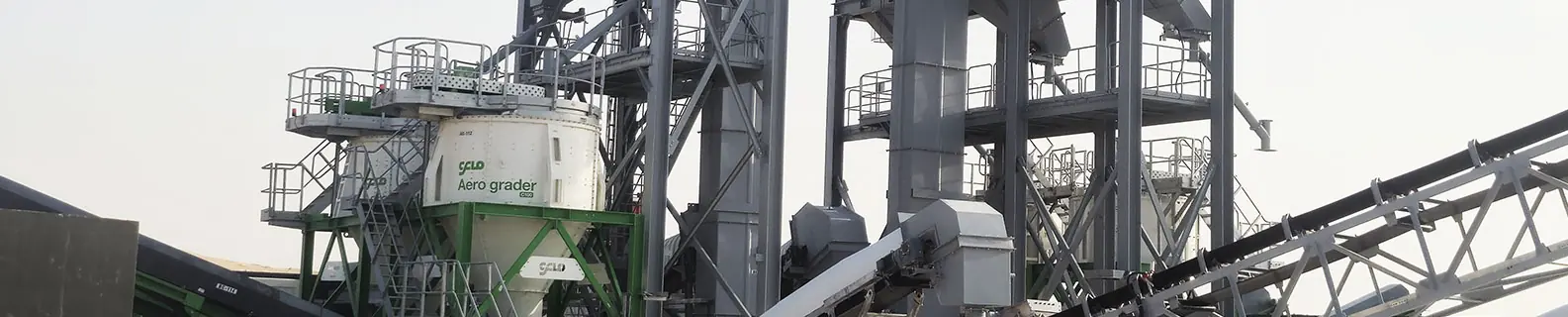
Dune and desert sand is abundant, clean and almost useless as it lies: wind sorting makes it too fine and too uniform in size, so it fails a concrete grading envelope and behaves badly in a mix. The correction is a bottom-end cut rather than washing, because the sand carries little clay and the regions holding it have no water to spare. Dry air classification removes the ultrafine tail and brings the gradation inside specification without using any process water.
Why the most plentiful sand on earth is the least usable
A desert holds enormous quantities of sand and almost none of it goes into concrete. The reason is the wind. Wind transport sorts grains far more narrowly than water does, so a dune deposit arrives as a single narrow size fraction, with rounded grains and a long tail of material below the sizes a mix can use.
That produces two problems at once. The grading curve is too steep to sit inside a concrete envelope, and the rounded grain shape gives poor interlock. It is why coastal cities surrounded by desert import sand, and why the deposit under everyone's feet is treated as unusable rather than as a resource.
The fix is at the bottom end, not the top
Unlike a river or pit deposit, desert sand is not dirty. It carries very little clay, silt or organic matter, so there is nothing much to scrub off. What it carries is too much of the finest fraction.
That makes this a classification duty rather than a washing duty. Remove the ultrafine tail and the remaining gradation moves towards the envelope; blend the corrected sand with a coarser crushed fraction and it can be brought inside it. Neither step needs water, which matters because the deposits sit where fresh water is the scarcest input on site.
Dry classification, because there is no water
The Aerograder makes the cut with air. No process water, no settling pond, no thickener and no tailings, which is what makes the economics work in an arid basin where a wet plant would need a water allocation nobody will grant.
It accepts feed below 5 mm at below 2% surface moisture, which describes desert sand as it lies, and cuts in the 75 to 100 micron region. In an enclosed circuit it runs year-round, and in an arid region the question of wet-season moisture does not arise at all.
Proven on a local deposit
A frac sand operation in the Middle East runs four Aerograder units in parallel on locally sourced dune sand, grading it into proppant against a specification with a hard limit on the fine fraction, using no process water at all. The measured results are reported in the Abu Dhabi case study.
That is the demanding end of this duty. A proppant specification is tighter than a concrete sand specification, so a deposit that can be brought inside the first can generally be brought inside the second.
The related CFlo platform
The related CFlo platform for this duty is the Aerograder air classification system, available at 60 to 70 and 120 to 150 tonnes per hour, and combinable where more capacity is needed.
Where the corrected sand goes
Construction sand for concrete and mortar once blended to a workable grading, frac sand and proppant where the silica quality supports it, and hotmix sand for bituminous road work, where the filler limit makes the bottom-end cut necessary in any case.
Frequently asked questions
Why can desert sand not be used in concrete as it is?
Because wind sorts it too narrowly. The grains end up within a single fine size range and rounded in shape, so the gradation is too steep for a concrete envelope and the interlock is poor. The problem is the size distribution and the shape, not contamination.
What is the difference between processing desert sand and river sand?
River and pit sand arrive dirty and well graded, so the duty is washing off clay and silt. Desert sand arrives clean and badly graded, so the duty is correcting the size distribution. That is why a wash plant is the answer to one and a classifier is the answer to the other.
Can desert sand be brought inside a concrete specification?
The gradation can be corrected by removing the ultrafine tail, and blending the result with a coarser crushed fraction brings it towards an envelope. Whether a given deposit gets fully inside one depends on its own particle size distribution and shape, which is what testwork establishes rather than a general claim.
Why not wash it?
There is little to wash off, and no water to wash it with. Desert sand carries very little clay or silt, so scrubbing achieves almost nothing, while a wet circuit in an arid basin needs a water allocation, a thickener and a tailings plan. A dry cut avoids all three.
Does it work in high ambient temperatures?
Yes. Dry classification has no water to lose to evaporation and no slurry to manage, which is part of why it suits arid conditions. The constraint is surface moisture in the feed rather than air temperature, and it needs to be below 2%.
What throughput is available?
The Aerograder C100 runs at 60 to 70 tonnes per hour and the C200 at 120 to 150 tonnes per hour, and units can be combined, as on the Middle East line running four in parallel. Standard capacity may vary with feed gradation and site conditions.