
Dry Air Classification Boosts Local Frac Sand Yields in the GCC
Abstract
Proppant for the oil and gas industry must be supplied in tight 20/40, 40/70 and 70/140 mesh size ranges, with minus 200 mesh (75 µm) fines held below 1%. The industry in Abu Dhabi imports the sand due to lack of suitable resources.
However, local dune and silica sand resources across the Gulf Co-operation Council offer a viable alternative to imported frac sand if the feed sand, which is variable and fine-rich, could be pre-treated to remove the fines before being subjected to dry screening for size separation.
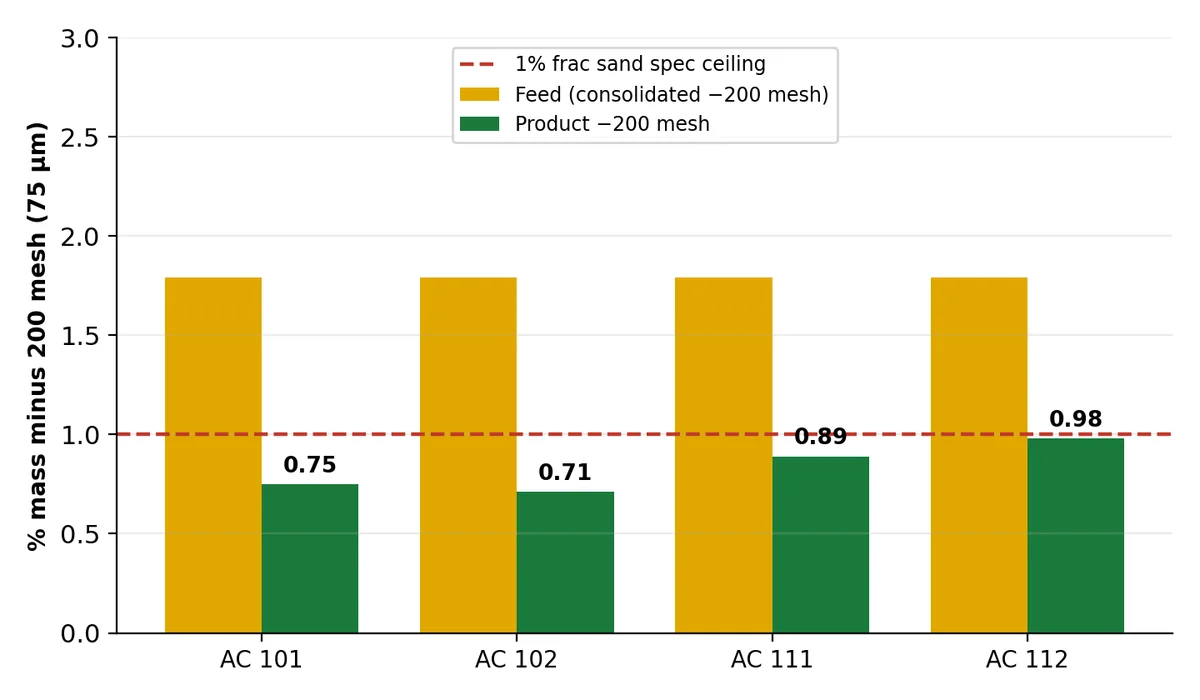
This paper reports field performance from a four-unit dry air-classification plant having a combined capacity of 280 TPH commissioned in Abu Dhabi for a major oil and gas services operator. Across a July 2026 verification campaign in which all four units (AC 101, AC 102, AC 111 and AC 112) were sampled at 70 TPH per unit, the minus 200 mesh (75 µm) fraction in the graded product averaged 0.83%, against a frac sand specification ceiling of 1%, and stayed within a narrow 0.71% to 0.98% band across the four machines. The mass yield to product was around 90% and recovery of the plus 140 mesh (106 µm) coarse fraction to product was about 94%. The separation was sharp, with a demonstrated median cut (d50) of approximately 290 mesh (54 µm), which is why the minus 200 mesh fines were stripped so cleanly. The cut was achieved on a feed concentrated below 30 mesh (600 µm), a tighter band than conventional dedusting duties and a more demanding case for the classifier.
Keywords: frac sand, hydraulic fracturing, air classification, dry processing, dedusting, GCC, proppant, local content, water-scarce operations.
Background: the need for local resourcing
Frac sand is high-purity quartz used as a proppant in hydraulic fracturing. Effective proppant must be hard, clean, well-rounded and tightly sized. The saleable mesh cuts of 20/40 (roughly 420 to 840 µm), 40/70 (roughly 212 to 420 µm) and 70/140 (roughly 106 to 212 µm) each carry an upper limit on minus 200 mesh (75 µm) fines, with a 1% ceiling on the grade.
Final sizing of frac sand is carried out on multi-deck dry screens that separate the feed into the 20/40, 40/70 and 70/140 product bands. Screen performance depends almost entirely on how well the upstream circuit manages minus 200 mesh material. When ultrafines are not stripped before the screens, fine particles wedge into screen apertures and reduce open area, misplaced material loops back through the circuit and erodes effective throughput, and minus 200 mesh fines that survive into product push the cuts over the 1% spec ceiling.
Across the GCC, operators have historically imported proppant from North America and India, paying for ocean freight, port handling and inland trucking resulting in high landed costs. If regional dune and silica sand resources, which are abundant but variable and fine-rich, could be pre-treated and used against imports, economics of unconventional gas development across the basin would change for the better. The path to that outcome runs through dry processing because water is scarce and surface tailings facilities attract environmental and regulatory scrutiny.
This paper reports field performance data from a four-unit dry-classification plant commissioned in Abu Dhabi for a major oil and gas services operator, with the results here drawn from a July 2026 four-unit verification campaign. The objective is to give process engineers, completion engineers and procurement leads in the region a documented numerical reference for what a dry pre-classification step can deliver, together with a clear view of where its limits lie. Where site water is constrained and the final product is sized on dry screens, an air-classification step placed ahead of the screens is a natural fit. Where water is available and the feed carries silt, clay or organic loads, a wet route remains the appropriate choice. The selection between a wet and a dry circuit is made on the merits of each feed and site.
Separation sharpness and shell geometry
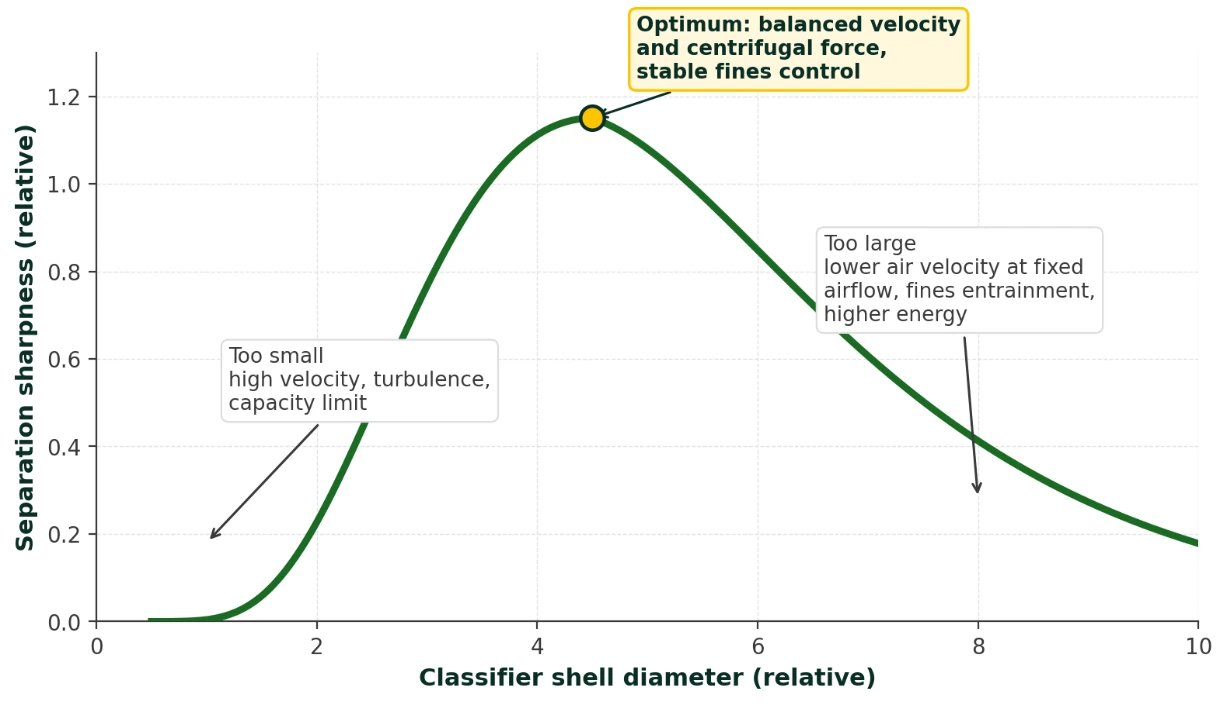
A common procurement instinct is to specify a larger classifier shell on the assumption that a bigger machine separates better and that fewer units are required for a given flow rate. But the physics does not support that instinct. Shell diameter influences circumferential velocity, residence time and machine loading, but separation sharpness at the cut point is set by the airflow field and cut-point control rather than by size alone.
Very large diameters reduce air velocity at a given airflow, weakening the drag that lifts fine particles into the rising stream and allowing them to entrain into the coarse product. The cut dulls, plus 140 mesh recovery falls and minus 200 mesh content in product drifts upward. Oversized shells also raise power to maintain velocity and add dust-handling complexity downstream. The result is a unimodal sharpness curve against diameter (Figure 1) with a clear optimum for a given airflow and capacity combination. Pushing past it costs sharpness and energy without any increase in yield.
The implication for plant design is that, depending on the separation size required, capacity scaling is best achieved by paralleling moderately sized units rather than applying a single oversized shell. This approach preserves the cut, holds the energy intensity per tonne and lets the plant keep running at reduced rate if one unit is taken offline, with common spares across the units as a further benefit. The Abu Dhabi installation reported in this paper follows that philosophy directly, using four parallel units rather than one oversized machine.
Performance evaluation of the installation
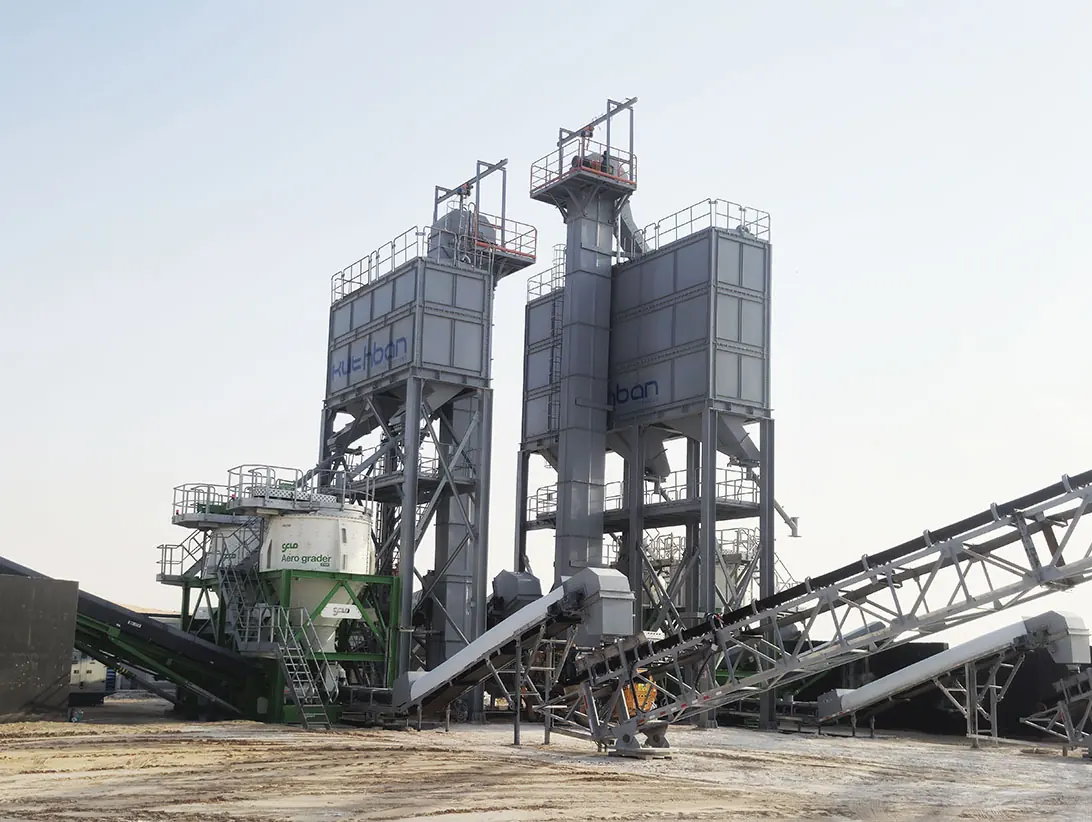
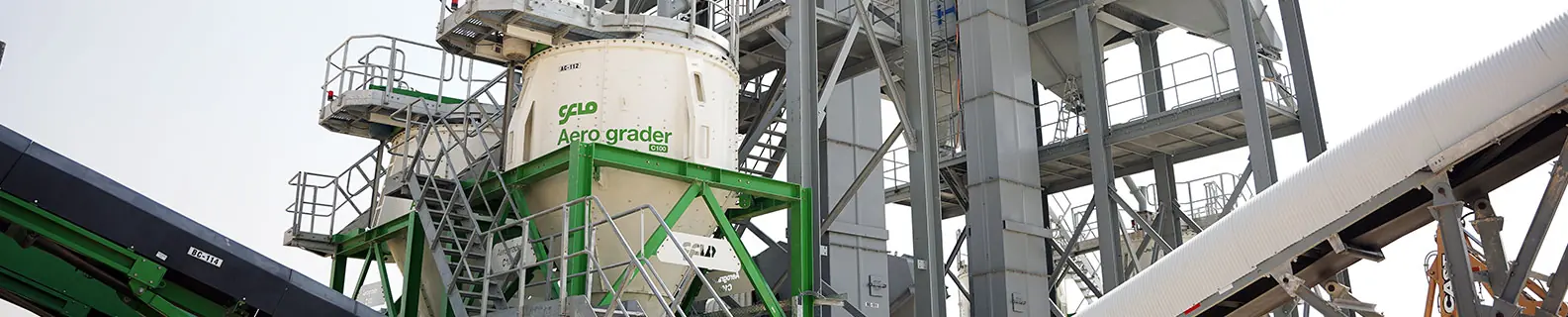
A four-unit air-classification plant was commissioned in Abu Dhabi for a major oil and gas services operator. The facility is rated at 4 × 70 TPH for a combined design capacity of 280 TPH. It grades local silica sand for use as a domestically sourced frac sand and discharges a graded, fines-free coarse product to multi-deck dry screens that produce the 20/40, 40/70 and 70/140 product bands. The plant operates as a dry circuit and uses an Aerograder C100-class unit on each of the four parallel lines (designated AC 101, AC 102, AC 111 and AC 112).
Performance was characterised over a July 2026 campaign in which feed and product streams were sampled at successively higher throughputs on a single unit, and then across all four units at the 70 TPH per-unit operating point. Trial conditions are set out in Table 1.
| Trial | Per-unit throughput | Fan duty | Configuration |
|---|---|---|---|
| 1 | 40 TPH | 30 Hz | Single unit, ramp-up |
| 2 | 50 TPH | 30 Hz | Single unit, ramp-up |
| 3 | 60 TPH | 30 Hz | Single unit, ramp-up |
| 4 | 70 TPH | 30 Hz | Single unit, design-point verification |
| 5 | 70 TPH per unit | 30 Hz | Four-unit parallel verification (AC 101/102/111/112) |
Table 1. July 2026 verification trial scheme.
Samples collected were sieve analysed. Consolidated data across the four units at the 70 TPH per-unit operating point is given in Table 2.
| Sieve range (mesh) | Av. size (micron) | Feed, wt. % | Product, wt. % |
|---|---|---|---|
| +16 | 1180 | 0.00 | 0.00 |
| –16 +40 | 800 | 0.10 | 0.15 |
| –40 +70 | 315 | 26.31 | 36.82 |
| –70 +100 | 180 | 38.88 | 39.23 |
| –100 +120 | 137 | 14.98 | 11.43 |
| –120 +140 | 115 | 7.35 | 5.01 |
| –140 +200 | 90 | 10.60 | 6.53 |
| –200 | 38 | 1.79 | 0.83 |
| Total | 100.00 | 100.00 |
Table 2. Consolidated air classifier performance at 70 TPH per-unit feed rate, averaged across the four units (AC 101/102/111/112). Values are percentage by mass in the feed and graded product.
It may be observed that the classifier is separating the fines (minus 200 mesh) quite effectively and the product carries only 0.83% minus 200 mesh material, against the 1% minus 200 mesh frac sand specification ceiling. The residual fines were held within a narrow 0.71% to 0.98% band across all four units. The yield to product is around 90%, and recovery of the plus 140 mesh coarse fraction to product is about 94%. It should be noted that 200 mesh is the specification gate against which the product is judged, not the cut point of the machine.
Particle size distribution
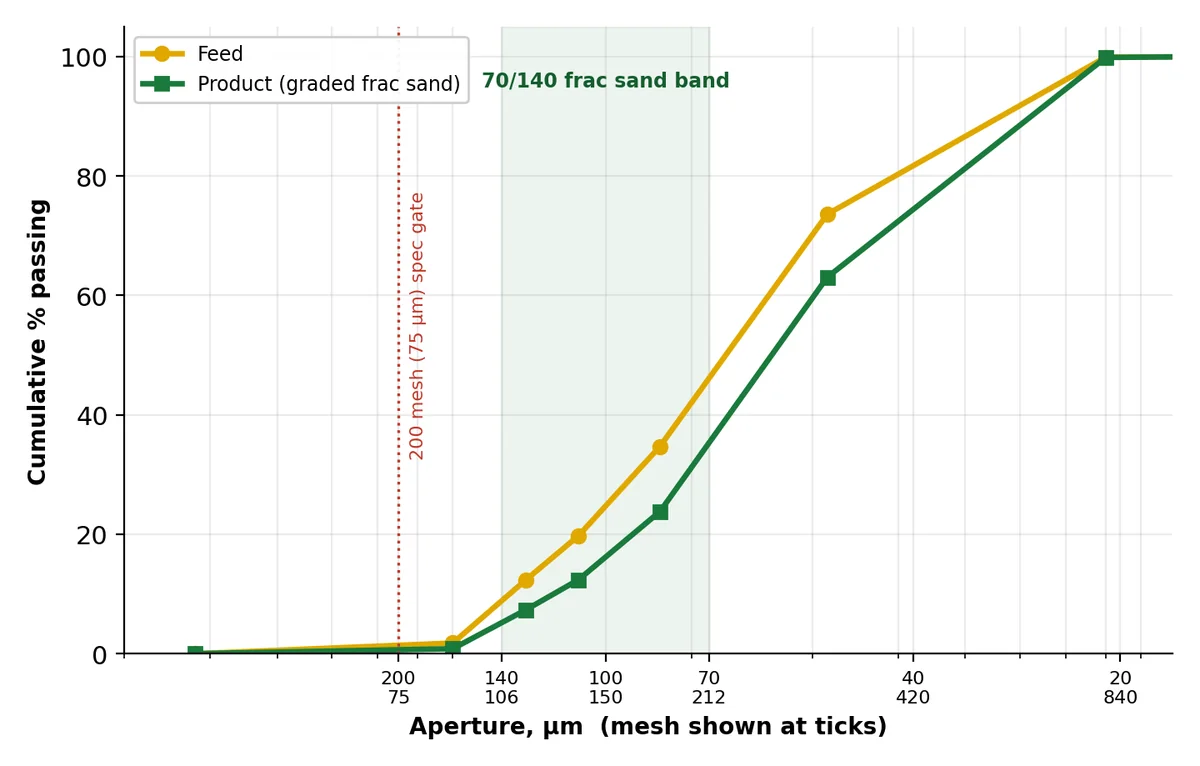
The demonstrated median cut (d50) is fine, at approximately 290 mesh (54 µm), well below the 200 mesh (75 µm) specification gate, which is precisely why the minus 200 mesh fraction is reduced so far below the 1% limit.
The nature of the feed matters here. The feed is concentrated below 30 mesh, whereas conventional dedusting duties typically handle a feed spread up to 4 to 5 mm. A feed with most of its mass packed close to the cut point gives the classifier less separation margin to work with, which makes the cut harder rather than easier. The Aerograder nevertheless held a sharp separation on this tight-band feed, cutting well below the 200 mesh specification gate, which is the more demanding case and a good indication of the resolution the machine can deliver.
The particle size distribution curves for the feed and graded product are given in Figure 3. The product curve sits to the right of the feed through the fines region, confirming that fines have been removed from the product.
Consistent performance across all four units
The trial schedule in Table 1 culminated in operation at the 70 TPH per-unit throughput, including a four-unit verification run in early July 2026. This confirms that paralleling preserves the per-unit capacity and cut. The results reported in this paper are based on the sampling campaign during these trials.
Across the campaign, the product stream carried minus 200 mesh content below 1% at every operating point, from the single-unit ramp-up through to the 70 TPH per-unit operating point on all four units. Each of the four machines (AC 101, AC 102, AC 111 and AC 112) held its product minus 200 mesh below the 1% ceiling on the same feed, confirming that paralleling preserves the per-unit cut and validates the capacity-by-replication design philosophy. Figure 4 shows that the performance was consistent across all four units.
The advantages of installing an air classifier ahead of the multi-deck screen for final size gradation are many. Fines do not reach the screen deck, so deck blinding and recirculation are almost eliminated, which helps maintain screening capacity. Energy per tonne of saleable product is reduced, screen wear is lower and product consistency improves.
The fines stream itself has commercial value in brick-making, cementitious blends and filler markets. When the fines are taken up by these blender markets, the great majority of the feed is converted into saleable product, which strengthens the overall project economics.


Implications for local frac sand sourcing in the GCC
Successful installation and operation of the Aerograder C100 air classifier by CFlo World Limited has established that the machine can be used effectively to separate minus 200 mesh fines from sand obtained from local dunes, and to help produce tightly graded frac sand to the relevant size specifications. This would not only reduce imports from other countries but, with the other advantages noted above, would also reduce the unit cost of the final product. The consistent performance across all four units and over a range of operating conditions indicates flexibility in operation and the ability to accommodate a range of tonnages and feed variations.
There are, however, limitations to dry separation. It cannot address feed problems such as the presence of organics, or sand coated with silt, mud or clay. Dry classifiers also cannot function efficiently with wet feed carrying more than 5 to 6% moisture. In all these cases wet processing, including scrubbing would become necessary. CFlo World Limited can address such situations with its wet processing technology, so that the choice between a dry and a wet route can be made on the merits of each feed and site.
References
ASTM E11, Standard Specification for Woven Wire Test Sieve Cloth and Test Sieves, used as the reference for mesh-to-aperture conversion.
API RP 19C / ISO 13503-2, Measurement of Properties of Proppants Used in Hydraulic Fracturing and Gravel-Packing Operations.
Download this case study as a PDF
Enter your details and the PDF arrives in your inbox within moments.
Your site could be next
Talk to our engineers about plant configuration, capacity and payback for your material.
Contact Us