
Hotmix Sand for Bituminous Roads
Dedusting sand before it reaches the asphalt plant, so the mix stays inside its filler limit and no one pays to haul what the mix cannot use.
PlatformsAerograder
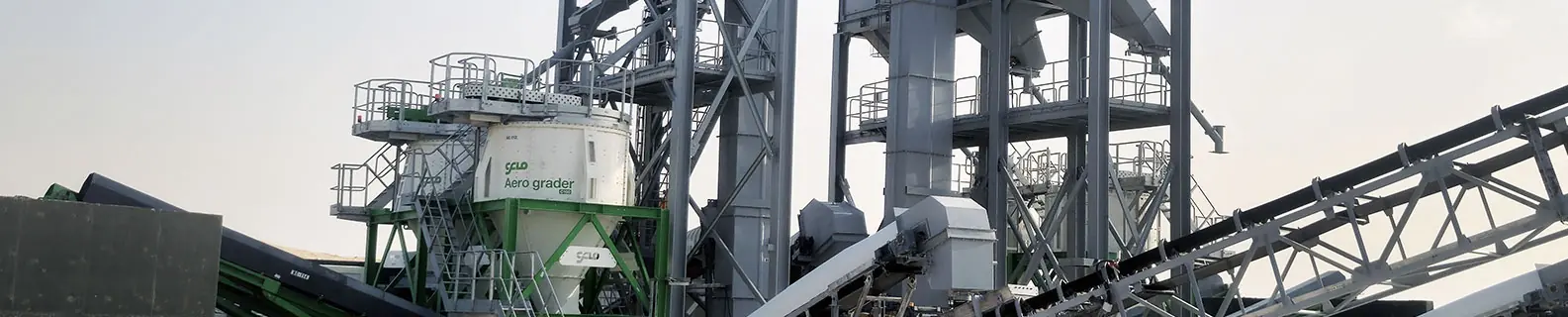
Hotmix sand is the fine aggregate fed to an asphalt plant for bituminous road construction. A bituminous mix will only tolerate a limited filler content, and an asphalt plant has little means of taking ultrafines out at its own end, so whatever arrives in the sand goes into the mix. Removing the ultrafines before the sand is hauled, by dry air classification, holds the mix inside its filler limit and means the contractor stops paying to transport material the mix cannot use.
The asphalt plant cannot fix this at its end
A bituminous mix is bitumen, coarse aggregate, fine aggregate and filler in a designed proportion. The filler fraction is specified, not incidental: too much of it and the bitumen demand rises, the mix stiffens, and the pavement behaves differently from the one that was designed.
An asphalt plant has very little ability to remove that fraction once the sand is on site. It proportions and heats what it is given. So the ultrafine content of the delivered sand is effectively the ultrafine content of the mix, and the only place to change it is upstream.
Sand is often hauled a long way to get there
Road projects are linear and asphalt plants sit where the work is, which is frequently a long way from a source of suitable sand. That haulage is one of the larger costs on a bituminous job, and it is charged by the tonne.
The consequence is easy to miss. Where the delivered sand carries a significant ultrafine fraction, the contractor pays to load, haul and unload material the mix will not accept, then pays again in bitumen demand once it is in the mix. Taking that fraction out at the source means only useful tonnes move, which is a saving on the transport bill and on the carbon that comes with it.
Dedusting is not a precision cut
Dedusting for a bituminous mix is a coarse duty. The aim is to take out as much of the dust as possible so the asphalt plant runs efficiently and the mix stays inside its filler limit. Whether the cut lands at 75 micron or nearer 100 changes little; what matters is how much of the fine fraction leaves before the sand is hauled.
Concrete sand is the opposite problem. There the grading envelope is the product, so the fine end has to be controlled to a cut point rather than simply reduced, and every fraction has to sit where the specification says.
That is why a contractor buys both rather than choosing between them. The Combo is built to produce concrete-grade sand and hold it inside a grading envelope. The Aerograder is the right tool where the job is simply to strip the dust off material heading for a hotmix plant, which needs no such precision.
Never wet the feed that is going to a bituminous mix
This is the part worth being clear about. Sand for a hotmix plant should not be washed on its way there. A bituminous mix needs dry aggregate for the bitumen to bond, and any moisture the sand carries has to be driven off in the dryer at the contractor's cost, with residual moisture risking stripping in the finished pavement.
So dedusting for hotmix is not a stage that follows a wash plant. The Aerograder takes the dust out of dry crusher dust directly, and the material goes to the asphalt plant still dry.
Why these contractors own both machines
GR Infraprojects, Dilip Buildcon and V. H. Khatri Construction all run Combo and Aerograder units, across both the C100 and the larger C200, and each of them runs more than one Combo.
They are two product lines on one site, not one circuit. The Combo produces washed concrete-grade sand, which is a precision duty and a wet one. The Aerograder produces dedusted hotmix sand, which is a coarse duty and has to stay dry. The same crusher can feed both; the material never passes through both.
The related CFlo platform
The related CFlo platform for this duty is the Aerograder air classification system, which makes the fines cut with no process water, no settling pond and no tailings to manage. Where the same site also sells concrete-grade sand, a Combo produces that as a separate line.
What we need to size it
The feed gradation, its surface moisture, the tonnage the asphalt plant draws, and the filler limit the mix design works to. The Aerograder takes feed below 5 mm and needs surface moisture below 2%, and it cuts in the 75 to 100 micron region. From there the cut point and the model follow. We pilot the material at our material testing lab rather than sizing from a table, because the ultrafine content of crusher dust varies with the rock and with the crusher setting.
Frequently asked questions
What is hotmix sand?
It is the fine aggregate portion of a hot mix asphalt batch, used in bituminous road construction. It has to sit inside a grading band and, critically, inside the filler limit the mix design allows, because the very fine fraction changes the bitumen demand and the stiffness of the finished pavement.
Why not let the asphalt plant remove the fines?
Because it largely cannot. An asphalt plant proportions, dries and heats the aggregate it is given; it has no classification stage that removes the minus 75 micron fraction. Whatever arrives in the sand goes into the mix, so the removal has to happen before the material is delivered.
How does dedusting save on transport?
Haulage is charged by the tonne, and road contracts often draw sand from a long way off. Every tonne of ultrafines hauled to the asphalt plant is a tonne the mix cannot use, paid for twice: once in freight and again in the bitumen it would demand. Removing that fraction at source means only useful tonnes travel, which also cuts the carbon attached to the haul.
Why use air classification for this rather than a wash plant?
Because the duty does not call for the precision a wash plant delivers. Dedusting only has to remove as much of the dust as it can; it does not have to place the fine end at a specific cut point, which is what a bituminous mix leaves room for and a concrete specification does not. Air classification does that job directly, with no water circuit, settling pond or tailings behind it.
Should the sand be washed first and then dedusted?
No. Washing puts moisture into material that a bituminous mix needs dry, and the asphalt plant then has to drive it off. The two machines serve two separate product lines on one site: the Combo makes washed concrete-grade sand, the Aerograder makes dedusted hotmix sand from dry crusher dust. The same crusher can feed both, but the material does not pass through both.
What throughput is available?
The Aerograder C100 runs at 60 to 70 tonnes per hour and the C200 at 120 to 150 tonnes per hour, and units can be combined for higher capacities. Standard capacity may vary with feed gradation and site conditions.