
Water Management and Tailings Recycling
Closed-loop water recovery and zero-discharge tailings, built into every CFlo plant as standard, and available on their own wherever a project needs them.
PlatformsComboReurbanMicrograderOremax
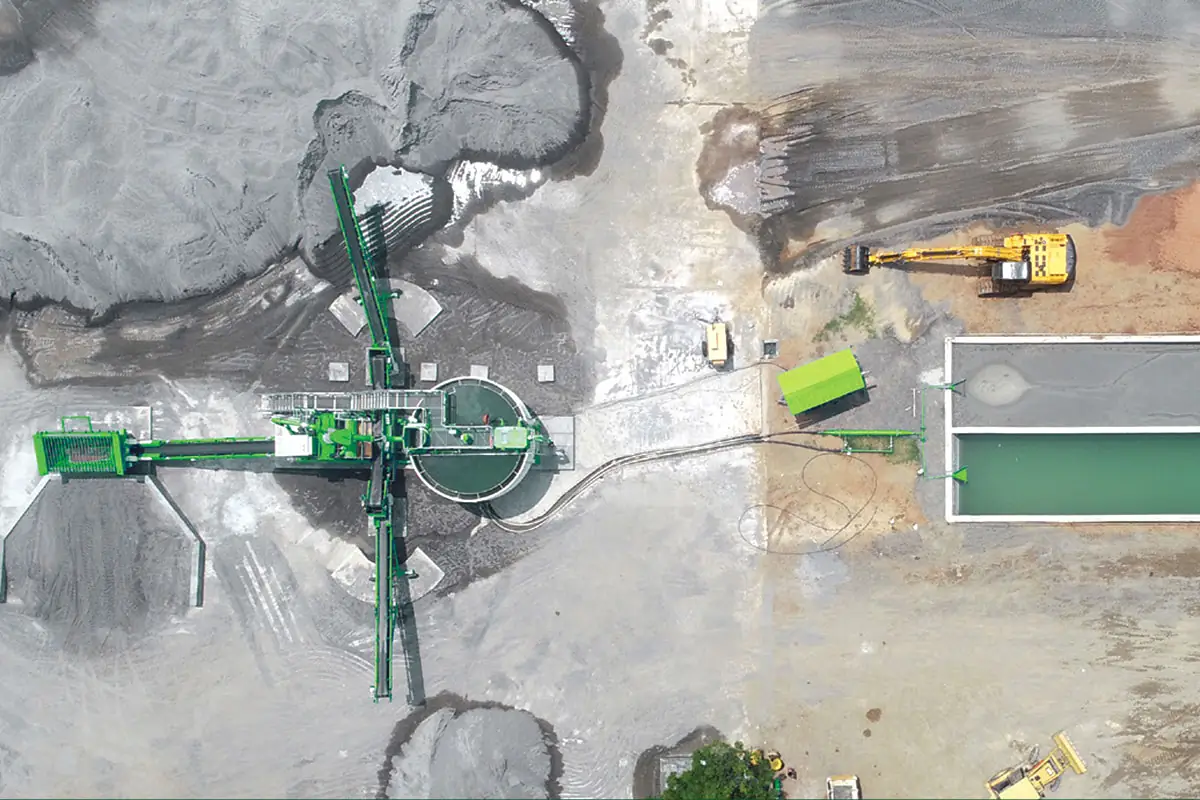
Every CFlo flagship plant, Combo, Reurban, Micrograder and Oremax, has Hydromax water recycling and Easysettle tailings management built in as standard, recovering the great majority of process water and returning thickened sludge as a trafficable cake rather than a pond. No liquid effluent crosses the fence. Both systems are also supplied on their own, for sites closing the loop on a plant they already run.
Built in, not bolted on
Most of this industry sells water treatment as a separate line: buy the wash plant from one supplier, the thickener from another, the polymer dosing from a third, and make them agree on site. That is how a plant ends up sprawling across acres with settling ponds behind it.
CFlo took the opposite decision. Feeding, screening, classification, dewatering, water recovery and sludge handling are folded into one chassis, so a Combo, Reurban, Micrograder or Oremax arrives with its water circuit already engineered, wired and factory tested. There is no integration project, because there is nothing to integrate.
That is why the water performance holds in the field rather than only in a brochure: the loop was closed at the design stage, not added afterwards.
Both are also supplied as standalone systems, and we take on water and tailings projects in their own right. If you run a wash plant already, from us or from anyone else, Hydromax and Easysettle are engineered to bolt onto an existing circuit, so an open-loop plant losing water to ponds can be closed without replacing it.
What it costs you to run an open loop
Without water recycling, a wash plant pays three times over, every hour it runs.
-
Land. Settling ponds occupy ground that could hold reserves, stockpiles or nothing at all. A thickener replaces them with a single tank on a fraction of the ground.
-
Water. Continuous fresh make-up to feed the plant, which is expensive where tariffs are rising and decisive where water is scarce.
-
Operating cost. Pond cleaning by excavator and dumper, operator hours, and the compliance risk of an overflow after heavy rain.
Hydromax: the water half
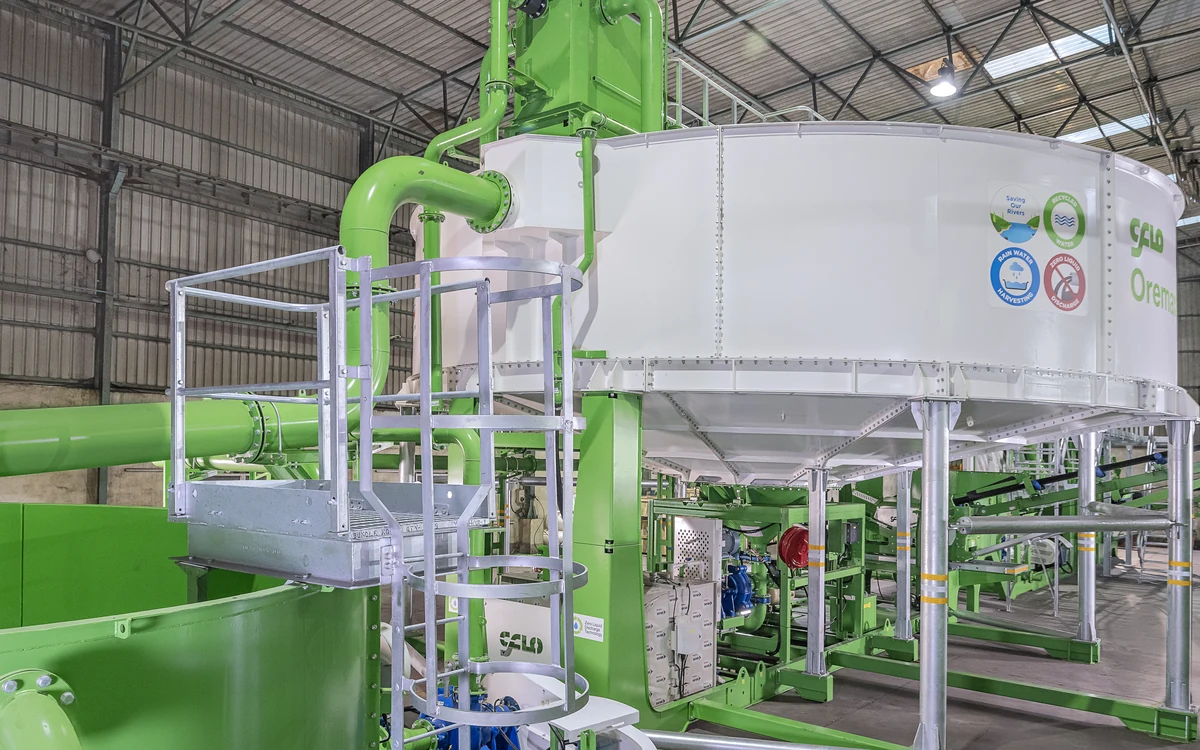
Hydromax is a high-rate thickener that replaces multiple settling ponds with one engineered tank. Slurry from the wash plant meets flocculant in a de-aeration chamber, where a baffle releases entrained air before it can disturb settlement. The conditioned slurry enters at the centre of the tank in laminar flow, giving suspended solids the longest possible travel path before clean water reaches the peripheral weir and gravity-feeds back to the plant.
A four-arm rake with angled scrapers conditions the sludge bed continuously, so solids consolidate to a pumpable density rather than compacting into a mass the pump cannot lift. When level probes read high, a pneumatic knife valve opens, the sludge pump discharges, and the pipework back-flushes automatically before the cycle repeats.
Every Hydromax ships with a matched Polydex dosing station: a multi-tank batch system that mixes, ages and doses polymer in sequence. Polymer that has not been given time to hydrate raises consumption and blocks dosing pumps, which is why the ageing step is not optional.
Easysettle: the tailings half
Recovering water leaves you with sludge, and a thickener alone just moves the problem to a pond. Easysettle treats it at the point of disposal: polymer is metered into the sludge line and blended by an inline mixer in transit, so the slurry rigidifies as it lands in the bay and releases clear water immediately.
The released water is pumped straight back to the wash plant. What is left dries to a firm cake, quickly enough and dry enough to drive an excavator onto. The unit runs on a PLC-controlled dosing cycle, with no civil foundations and no manual cake handling.
Easysettle is proven on iron ore, coal, alumina, mineral sands, gold, copper and manufactured sand.
Sizing and range
Hydromax spans a wide range of throughputs across its model line, shipped in standard open-top containers and bolted together on site with minimal civils. Model-by-model figures are on the Hydromax system page. Sizing follows the hydraulic feed rate, the solids loading and particle size, the mineralogy of the fines, and where the sludge is going.
Surface area is the lever that matters. Upward flow velocity falls as the tank widens, settlement stays laminar, and polymer consumption drops with it. Undersizing a thickener saves once at purchase and costs every tonne thereafter.
Retrofitted to another manufacturer's plant
Water management does not have to arrive with a new plant. MEGA Supplies, a garnet processor in the UAE, was running a wash plant built by another manufacturer and could not supply it with enough water to run as intended. CFlo supplied the water management system that closed the loop, recovering and recycling process water so the plant operated within what the site could actually deliver.
The circuit is the same one CFlo builds into its own platforms, which is what makes retrofitting it practical: it is designed as a stage of a wash plant rather than as a bolt-on treatment package.
Where it works
Sand and aggregates, mining and ore beneficiation, industrial sands for glass, foundry and frac, C&D and excavation waste recycling, and critical mineral circuits including lithium and rare earths.
Frequently asked questions
Is water management included, or bought separately?
With a CFlo plant it is included. Hydromax and Easysettle are built into the Combo, Reurban, Micrograder and Oremax ranges as standard, so the plant arrives with its water circuit already engineered, wired and factory tested, with nothing to integrate on site. We also sell and install both as standalone systems, and take on water and tailings projects on their own merits.
How much process water can actually be recycled?
In a closed-loop configuration the great majority of it, with fresh water needed only to replace what leaves in the product and the sludge cake. The figure for your plant depends on your feed, your fines content and the product moisture you are targeting, and we will put a number to it against your own material rather than a brochure average.
What is a high-rate thickener and why not just use settling ponds?
A high-rate thickener uses controlled flocculant dosing to settle solids in minutes rather than days, in one tank instead of several ponds. Ponds occupy land, lose water to evaporation and seepage, need excavator cleaning, and overflow in heavy rain. A thickener replaces all of that with a predictable, automated cycle.
What happens to the sludge?
Easysettle rigidifies it at the point of disposal so it releases its water immediately and dries to a cake you can drive on. Where a site needs a filter press or centrifuge instead, the Hydromax discharges to those just as readily, and we supply them through our industry partners as part of the same package. The right answer depends on your material, your space and what you intend to do with the cake.
What flocculant does the system use?
An anionic polyacrylamide of high molecular weight, prepared and metered by the Polydex station. CFlo supplies Ecoblu, a medium-anionic grade that works across a wide pH range and is formulated for fast zone settling and clear overflow. Dose is always set by jar test on your own slurry, because mineralogy, particle size and water chemistry all move the optimum.
Can this be retrofitted to a plant I already own?
Yes. Hydromax and Easysettle are supplied as standalone systems as well as built into CFlo plants, and both are designed to bolt onto an existing wash circuit. Send a material sample or request a pilot test and we will size it against your actual slurry.