
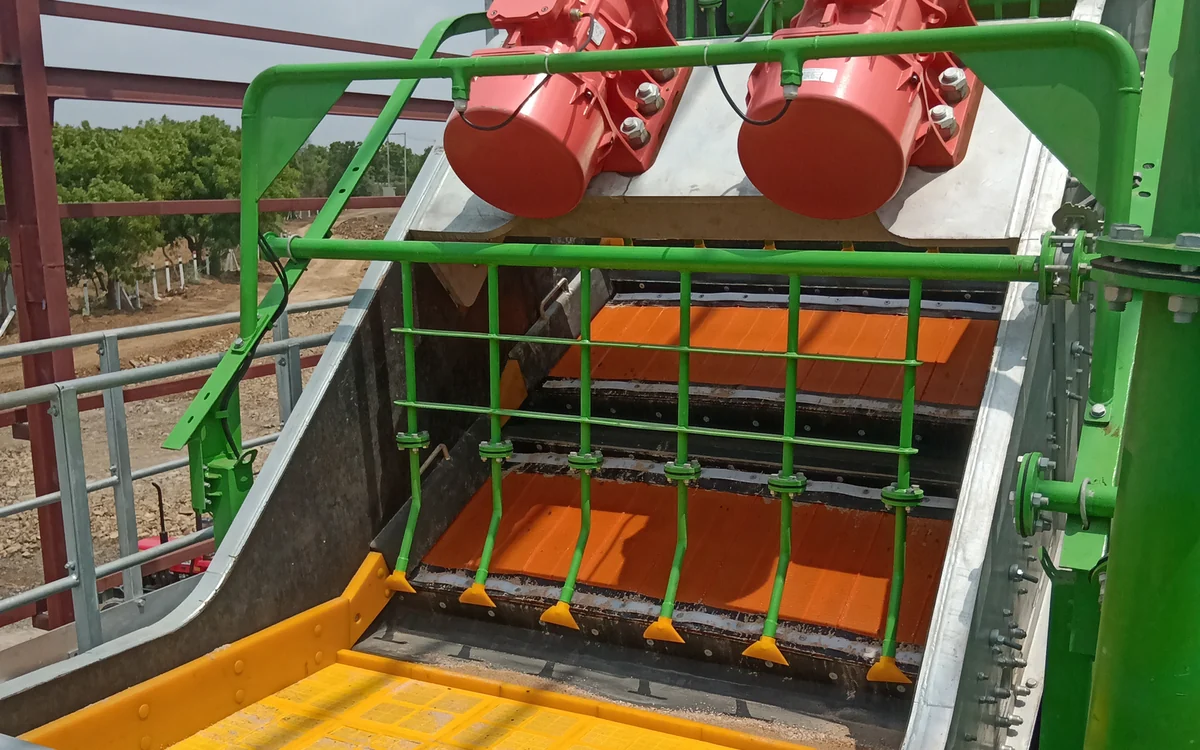
Screenmax FS86 High Precision Fines Screen
Multiple screening passes on one frame, then dewatering on the same deck.
The CFlo Screenmax FS86 is a High Precision Fines Screen, a wet screen that makes cuts between 300 and 800 microns at 50 to 100 tonnes per hour. A stepped multi-stage deck breaks and re-slurries the bed several times across one frame, so the separation is made repeatedly rather than once, and the final deck section dewaters the product to 12 to 14% moisture for discharge straight to a conveyor. It is built into CFlo industrial sand plants and is also supplied on its own.
Why flat decks lose product
On a conventional flat inclined screen the bed compacts as it travels. Fines work their way under the coarse layer, ride the surface to the discharge end and leave with the oversize. The bed gets one attempt at the aperture and it is never refreshed, so undersize you have already paid to produce leaves in the wrong stream.
That loss is not a media problem and it cannot be tuned out with stroke or angle. It is what happens when a compacted bed is given a single pass.
Industries this plant serves
The stepped deck
The Screenmax FS86 deck is not flat. It is a series of stepped stages at changing angles, and every step transition does three things at once.
The bed breaks as material drops from one stage to the next, so the compacted layer comes apart and trapped fines are re-exposed to the aperture. The bed thins in the moment of free fall, giving near-size particles direct access to the screening surface instead of a route over the top of it. And each transition is where spray bars repulp the bed, reintroducing a controlled volume of water that converts the compacted mass back into a slurry ready to be screened again.
The result is several separations in series inside one machine on one footprint, which is why the FS86 clears near-size material that a single-pass screen carries through.
Full-width feed
Most screens are fed at a single point in the centre and leave bed distribution to gravity. The bed then runs deep in the middle and starves at the edges, so part of the media is overloaded and part of it is doing nothing, and the separation drifts with feed rate.
The FS86 uses a full-width feedbox that spreads slurry across the whole deck before the first panel. Bed depth is even, the media works at its designed open area across the full width, and the separation holds anywhere in the 50 to 100 tph envelope rather than only at the rate it was commissioned on.
Media that does not blind
Fine apertures blind. The FS86 uses modular polyurethane panels with engineered flex, so the panel geometry works with the stroke to release near-size particles on each cycle rather than letting them wedge.
Panels are side tensioned. A two-person crew can change the whole deck in a single shift with hand tools, which matters more than it sounds: a screen that is difficult to re-panel gets run on worn media, and worn media is where the separation quietly goes.
Dewatering on the same deck
The last deck section is a dedicated dewatering panel. Product leaves the screen at 12 to 14% surface moisture, dry enough to go straight onto a product conveyor.
Conventionally that means a second machine: a fine screen, then a transfer chute, then a dewatering screen, each with its own structure, drive, power and maintenance. Building the dewatering panel into the same frame removes a whole equipment stage from the flowsheet, and with it the footprint, the capital and the transfer point.
Built for continuous vibration
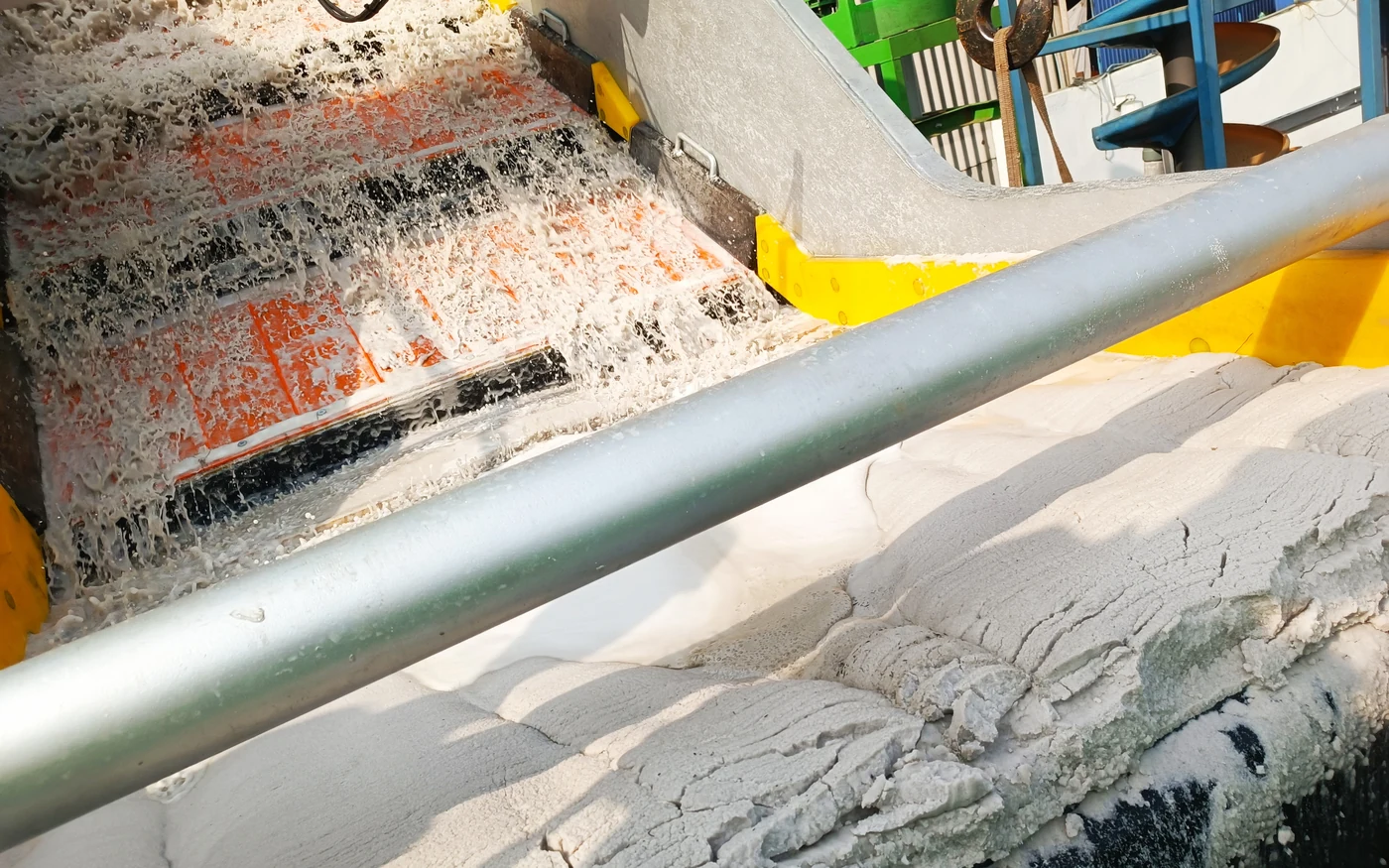
Fine screens run under constant high-frequency vibration, and that is what eventually kills them. Welded frames work-harden along the weld line and crack. The FS86 frame is fully bolted, so load is carried across the joint area rather than concentrated at a weld, and individual structural members can be replaced on site without cutting or welding.
The whole structure is hot-dip galvanised inside and out, which for permanently wet duty is the difference between a frame that lasts and a painted one quietly corroding under its coating. Frame mass and stiffness are matched to the exciter output so the motion stays cleanly linear, and oscillating mounts keep the dynamic load out of the supporting steelwork.
Screenmax is a family, not a machine
Screenmax is the screen range. Three families sit inside it, and they do different jobs at different points in a plant.
| Family | Models | What it does |
|---|---|---|
| High Precision Fines Screens | FS86 | Holds a narrow band in the fine sand range, and dewaters on the same deck |
| Dewatering & Sizing Screens | B63, A65, C43, E23 | Sizes and dewaters the main product streams at the product end |
| Circular Motion Rinsing Screens | G215, G315, G218, G318 | Sizes and rinses coarse material |
The Dewatering & Sizing Screens are housed on the Centriscreen Dewatering & Sizing System, which supplies the structure, the cyclone stage and the stockpiling conveyors around them.
The Circular Motion Rinsing Screens do the coarse sizing duty inside the Combo, Reurban and Oremax plants. They are high-energy single-shaft, two-bearing wet screens on rubber springs, which is what lets them handle coarse, heavy feed continuously.
This page is about the FS86, which is the precision end of the range. A plant making a specification sand usually runs more than one family: coarse rinsing at the front, dewatering and sizing at the product end, and an FS86 wherever a band has to be held exactly.
Where it fits in the circuit
The Screenmax FS86 is a standard part of CFlo Micrograder industrial sand plants, where the top of the gradation has to be held precisely, and is supplied on its own for existing circuits.
It is specified wherever the product is defined by a narrow band rather than a nominal size: silica and glass sand, frac sand and proppant where API sieve bands decide whether the product sells at all, foundry sand graded to AFS, beach sand and sea sand processing, and manufactured sand where the fines fraction governs the concrete grading envelope.
Because the deck can be configured to split more than one product in a single operation, one machine can hold several sand grades at once rather than running them as separate campaigns.
Key parameters
| Parameter | Screenmax FS86 |
|---|---|
| Typical cut point range | 300–800 microns |
| Feed rate | 50–100 tph |
| Drive | Twin exciter, linear motion |
| Deck profile | Stepped multi-stage, multiple passes on one frame |
| Screening media | Non-blinding modular polyurethane, side tensioned |
| Discharge moisture | 12–14%, no downstream dewatering screen |
| Structure | Hot-dip galvanised, fully bolted |
| Media change | Full deck in a single shift, two-person crew |
Cut point, media specification and open area are selected against your material rather than from a table, because the aperture that holds a band on one sand will not hold it on another.

Frequently asked questions
What is a high precision fines screen?
A wet screen built to hold a specific size band rather than simply remove oversize. In the fine sand range the difference matters, because a product sold on a sieve specification is worth what it is worth only if the band is actually held.
Why is a stepped deck better than a flat one?
A flat deck gives the bed one chance at the aperture and the bed compacts as it travels, so fines end up trapped under the coarse layer and leave with the oversize. A stepped deck breaks and thins the bed at every transition and re-slurries it with spray water, so the same material is presented to the aperture several times.
Do I still need a dewatering screen after it?
No. The final deck section is a dewatering panel and product leaves at 12 to 14% surface moisture, which is dry enough to convey. That removes a machine, a transfer chute and a piece of structure from the flowsheet.
Screen or classifier for a fine sand cut?
Both, usually, at different points. A screen fixes the top of the gradation. Below roughly 300 microns a screen starts to blind and a Vertimax upward flow classifier holds the mid-range cut more sharply, with hydrocyclones taking the bottom. A frac sand plant typically runs all three, each doing the part of the gradation it is actually good at.
How often do panels need changing?
It depends entirely on the abrasiveness of your material and the hours you run. The non-blinding geometry extends useful life, and because a full deck change is a single-shift job with hand tools, replacement can be planned into a maintenance window rather than forced by a breakdown.
Can you prove the separation before I buy?
Yes, and it is the better way to specify a machine. CFlo runs a full-scale FS86 pilot unit at our test facility. Send a representative sample and it is run at production conditions on your material, with feed, oversize and undersize all sampled and analysed, and a report issued with particle size distribution curves and a mass balance. The production machine is then specified from that data.