
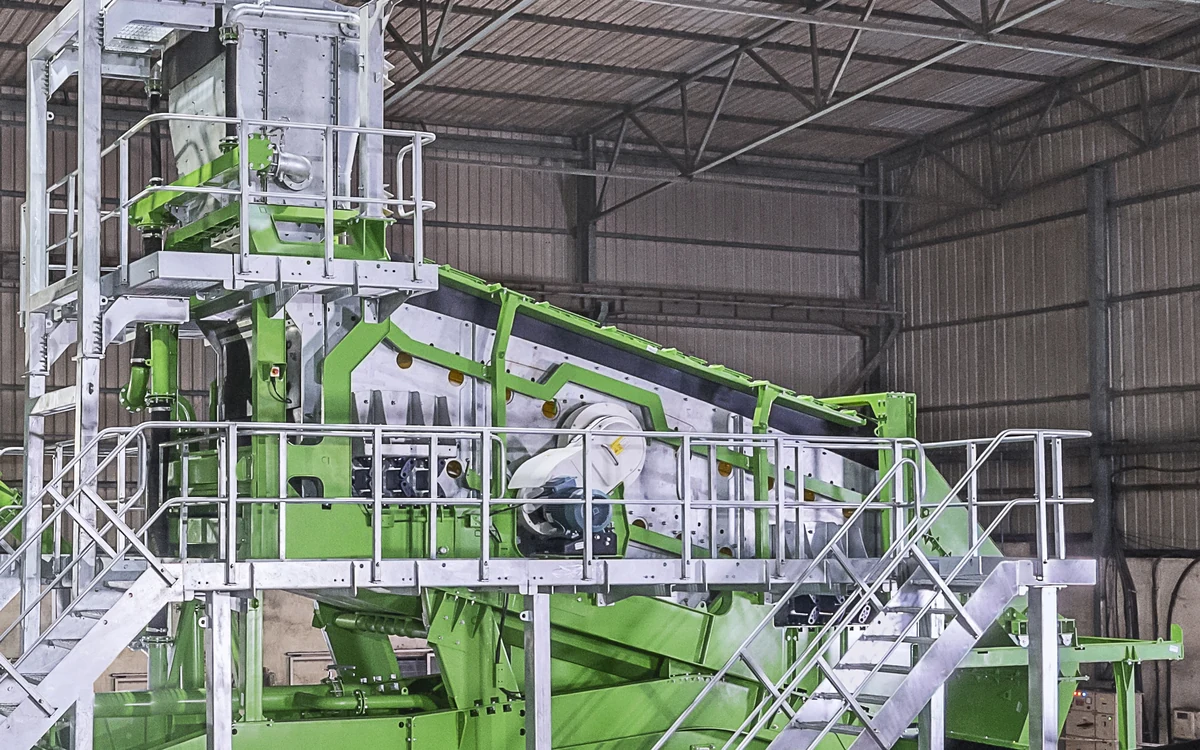
Screenmax G Series Circular Motion Rinsing Screens
Size it and wash it in one pass, on two or three decks.
The Screenmax G series are circular motion rinsing screens: inclined, multi-deck wet screens that size coarse material and wash it at the same time. An eccentric shaft running in two bearings throws the whole screen box in a true circle, spray bars flood the bed as it travels, and the material leaves split into size fractions and rinsed clean. They do the coarse sizing duty inside the Combo, Reurban and Oremax plants.
Sizing and rinsing at the same time
Near the front of a wash plant the job is not precision. It is volume: take a wide, dirty, coarse feed and split it into usable size fractions while washing the dirt off it.
A rinsing screen does both at once. Spray bars run the length of the deck, flooding the bed as it travels, so the water is not just wetting the material, it is driving the undersize through the apertures and carrying silt and clay away with it. Screening wet rather than dry roughly doubles what a given aperture will pass, and it stops the near-size particles that blind a dry deck within minutes.
Which is why the same machine that sizes your 20 mm also produces a cleaner 20 mm than a dry screen ever will.
Circular motion, and why it suits this duty
The G series is a single-shaft, two-bearing screen. An eccentric shaft rotating in two bearings throws the entire screen box in a true circular path, rather than the straight-line stroke of a linear screen.
That circular throw is the right motion for coarse wet duty for three reasons. It tumbles the bed rather than sliding it, so particles present themselves to the aperture in different orientations instead of riding flat over it. It conveys material down the incline steadily, which keeps the bed thin enough to screen rather than piling up at the feed end. And it is forgiving of the surges and lumps a plant's front end actually sees, where a linear screen tuned for a fine cut would be labouring.
Linear motion is the better answer at the fine, precise end of the plant, which is exactly where the Screenmax FS86 sits with its twin exciters. The two motions are not competing; they are for different parts of the gradation.
Two decks or three
Decks stack vertically over one base, and each one you add is another split from the same machine, the same drive and the same footprint.
Two decks give three products: oversize off the top, a middle fraction off the lower deck, and the undersize that passes both. Three decks give four. On a site selling several aggregate sizes that is the difference between one machine and two, and between one structure, one drive and one set of walkways and two of everything.
The trade is bed depth and access. More decks means more screening area in the same plan area but a taller machine and a longer media change, so the deck count follows the product list rather than the tonnage.
Rubber springs
The screen box is isolated on rubber springs rather than steel coils.
A wet screen at the front of a plant runs continuously under a heavy, uneven load, and the dynamic forces it generates have to be kept out of the supporting steelwork. Rubber springs damp better than steel at the amplitudes a circular screen works at, they do not ring, and they do not fatigue and snap the way a coil eventually does. They also cost the plant less noise, which matters more than it used to on sites near housing.
The model range
Four models, in two and three deck configurations across two deck widths.
| Model | Decks | Deck width |
|---|---|---|
| G215 | 2 | 1.5 m |
| G315 | 3 | 1.5 m |
| G218 | 2 | 1.8 m |
| G318 | 3 | 1.8 m |
The code reads directly: G, then the number of decks, then the deck width in decimetres. A G318 is a three-deck screen on a 1.8 m wide deck.
Deck length, aperture, media type and the spray bar arrangement are all set against the duty. A screen that is right for rinsing clay-bound gravel is not the one that is right for sizing a clean crushed product, even at the same tonnage.
Where it fits in the circuit
The G series does the coarse sizing and rinsing duty inside the Combo sand washing plants, Reurban C&D recycling plants and Oremax beneficiation plants. The screen on a Strato scalping screener is one of the same family.
It sits after scalping and ahead of the fine end of the plant, so a typical flowsheet runs a G series screen for the coarse split, a Scrubmax logwasher where the feed is clay-bound, and then the fines circuit: cyclones, a Centriscreen at the product end, and an FS86 wherever a band has to be held exactly.
Typical duties are aggregate washing, sand and gravel washing, manufactured sand, C&D waste recycling, iron ore and limestone.
The water it uses is not lost: in a CFlo plant the spray water is recovered by Hydromax and the silt it carries away is handled by Easysettle.

Frequently asked questions
What is a circular motion screen?
A vibrating screen whose box is thrown in a true circular path by an eccentric shaft running in two bearings, rather than in a straight line. The circular throw tumbles and conveys the bed at the same time, which suits coarse, wet, high-volume duty.
Circular or linear motion: which do I need?
Both, usually, at different points. Circular motion handles the coarse rinsing and sizing at the front of the plant, where the feed is variable and the volume is high. Linear motion, as on the FS86, is what holds a precise fine cut at the product end.
Why screen wet rather than dry?
Because water does most of the work. Spray bars drive undersize through the apertures instead of letting it ride over the top, wash silt and clay off the stone as it travels, and stop the near-size blinding that closes a dry deck down. The product is both correctly sized and clean.
Two decks or three?
It depends on your product list rather than your tonnage. Two decks give you three products, three decks give you four, from one machine and one drive. More decks means a taller machine and a longer media change, so the answer is the number of splits you actually sell.
What does the model number mean?
G, then the number of decks, then the deck width in decimetres. A G215 is a two-deck screen on a 1.5 m deck; a G318 is three decks on 1.8 m.
Can I buy one on its own?
Yes. The G series is built into the Combo, Reurban and Oremax plants, and is also supplied as a standalone screen for a circuit you already run.