
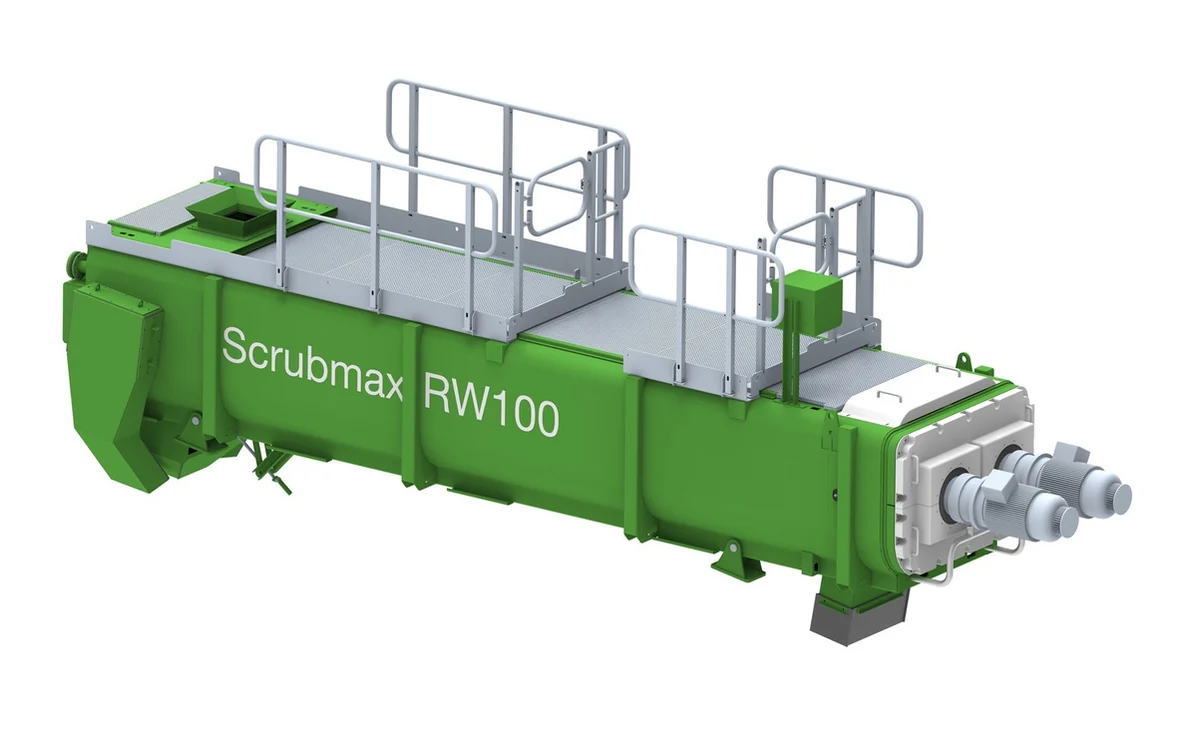
Scrubmax Twin Shaft Logwasher
For ore, limestone or aggregate a spray bar will not touch. Attrition on twin timed shafts.
The CFlo Scrubmax is a twin shaft logwasher that removes bonded clay, silt and organic contamination from ore, limestone and aggregate by driving the material against itself in a water bath. Counter-rotating shafts carrying spiral high-chrome paddles create material-on-material attrition that a wash screen cannot reproduce. It is as much an ore preparation machine as an aggregate one: run-of-mine iron ore with adhering clay and marly limestone are two of its most common duties. Three models cover 30 to 200 tonnes per hour, and it is supplied both inside CFlo plants and on its own.
When washing is not enough
Some contamination rinses off. Plastic clay bonded onto ore or aggregate does not. It survives a spray bar, survives a wash screen, and arrives in the product as a coating.
What that coating costs you depends on what you are selling. On aggregate it fails the sand equivalent test, weakens the bond in concrete and turns a saleable product into a rejected one. On iron ore it is worse than a nuisance: adhering clay and silica dilute the Fe grade, so you pay to haul and process gangue and then sell ore at a lower price than the deposit deserves. On marly limestone, where the clay and marl are interbedded with the rock, scrubbing is what separates a cement or aggregate feed from a reject, because the contaminant is soft and the product is not.
A logwasher works differently. Material is held in a water bath and forced against itself, so the scrubbing is done by the material rather than by water pressure, and the harder the feed the more effectively it scrubs. Clay and marl are sheared off, silt goes into suspension, and lightweight organics float and leave over the weir instead of reporting to the product.
It is a disintegration machine as much as a washing one: soft, clay-bound lumps that arrive intact are broken down and carried away in the water, while the competent rock or ore survives the trip and leaves over the weir.
Industries this plant serves
How the Scrubmax scrubs
Contaminated feed enters through a rubber-lined chute into the centre of the machine. Two counter-rotating shafts carrying spiral-arranged paddles work it up an incline of 7 to 9 degrees against the flow of water.
The paddles do not simply stir. They are arranged so the material forms a compacted mass that grinds against itself, and their faces are corrugated to raise the shearing action at every contact. Clean material passes over an adjustable weir at the discharge end, while lightweights float off the top. The weir position sets the water level and therefore the retention time, which is the primary adjustment for how hard the machine scrubs.
Two motors instead of a coupling
A conventional logwasher is driven by one motor through belts and a fluid coupling. That is a chain of components which all wear, all need attention, and all sit between the motor and the work being done.
Each Scrubmax shaft has its own geared motor. There are no belts and no fluid coupling, which removes the wearing parts and shortens the drive end. Each shaft can be run at its own speed, each has its own overload protection rather than sharing one across the machine, and the geared motor starts under load directly.
The shafts still have to stay timed, because intermeshing paddles that lose synchronisation collide. Spur gears at the drive end handle that mechanically, on a CNC-machined drive plate heavy enough to hold gear spacing against the separating force the teeth generate under load.
Paddles built to be worn out slowly
The paddles take all the abuse in a logwasher, so they are deliberately overbuilt: high chrome cast iron at 550 to 600 Brinell, with a 75 mm leading edge on the largest model.
They are arranged in a spiral rather than in line. In-line paddles strike the material bed all at once, and that repeated shock load is what fatigues bearings and drives. A spiral arrangement means paddles enter the material continuously, so the load on the bearings is constant instead of hammering.
The wear protection extends past the paddle itself. Each casting wraps around its mounting bracket so the bracket never contacts abrasive material, and a chrome wear shoe of matched hardness covers the gussets and the recessed bolt heads. Paddles are held on three Grade 10.9 bolts and change individually.
Bearings are the machine's real lifespan
Bearings are what usually decides how long a logwasher lasts, because they sit at the end of a shaft immersed in abrasive slurry. The Scrubmax mounts them externally, well back from the shell and above the water line, so sand and water have to travel to reach them.
Then it seals them in stages: a nitrile radial lip seal, a grease-packed three-stage labyrinth, twin flinger discs, a high chrome face plate and a rubber disc. The bearings themselves are SKF spherical rollers with a long rated life and, just as usefully, off-the-shelf availability anywhere in the world. Stub shafts are EN24 tool steel for fatigue resistance, the front assembly allows float for thermal expansion, and an inspection cap allows condition checks without disassembly.
Temperature sensors are fitted as standard on the rear bearings. A bearing that is beginning to fail runs hot before it fails, and that warning is the difference between a planned replacement and an unplanned one.
The shell
The shell is made from single-piece folded side sheets with the minimum of welded joints, and its profile is designed so that material forms its own bed against the wall. The bed then takes the wear instead of the steel.
Inspection hatches allow paddle wear to be checked without stripping the machine, an upward-flow manifold can be fitted where lightweights need positive removal, and pivoted feet set the working angle.
On ore, the scrubber is a grade decision
On an aggregate site a logwasher protects a specification. On an ore body it changes what the deposit is worth.
Adhering clay and weathered fines are gangue: they travel with the ore, take up capacity in every machine downstream, and dilute the grade you are paid on. Scrub them off at the front and the concentrate that reaches your gravity or magnetic stage is a cleaner, more concentrated feed, so the whole circuit behind it works on ore rather than on the material stuck to it.
That is why the Scrubmax sits at the head of Oremax beneficiation plants on run-of-mine iron ore, and why it earns its place on marly limestone, chromite and manganese, where the contaminant is softer than the product and attrition is the cheapest way to tell them apart.
Where it fits in the circuit
The Scrubmax handles the coarse end of the scrubbing duty, taking feed up to 100 mm. Below about 5 mm, where contamination is a film on the grain rather than clay between particles, the Atropure attrition scrubber takes over. Plants working badly contaminated deposits frequently run both.
It is a standard part of CFlo Oremax beneficiation plants and Reurban C&D recycling plants, and is supplied on its own for existing circuits. Typical duties are iron ore with bonded clay, chromite, manganese ore, limestone, aggregate washing, C&D waste and contaminated soil remediation.
Model range
| Parameter | RW50 | RW100 | RW200 |
|---|---|---|---|
| Capacity (tph) | 30–60 | 50–100 | 100–200 |
| Max feed size | 75 mm | 100 mm | 100 mm |
| Drive | 2 geared motors | 2 geared motors | 2 geared motors |
| Total power | 37 kW | 60 kW | 75 kW |
| Working angle | 7–9° | 7–9° | 7–9° |
| Water requirement | 30–50 m³/hr | 40–60 m³/hr | 50–80 m³/hr |
| Length | 6,500 mm | 8,780 mm | 10,720 mm |
Sizing follows tonnage and top size, but retention time is what actually decides whether the clay comes off, so a heavily contaminated feed can justify a larger machine than the tonnage alone suggests.
See it in action

Frequently asked questions
What is a logwasher?
A machine that removes bonded clay and organic contamination from coarse material by attrition rather than by washing. Material is held in a water bath and worked against itself by paddles on rotating shafts, so the scrubbing is done material against material. It suits ore as much as aggregate: iron ore with adhering clay, marly limestone, chromite and manganese are all standard duties.
Logwasher or attrition scrubber?
Size decides it. A logwasher works on coarse material up to around 100 mm where the contaminant is clay between and around the lumps, whether those lumps are ore, limestone or aggregate. An Atropure attrition scrubber works below 5 mm where the contaminant is a film on the individual grain. Many plants need both, at different points in the circuit.
Do I need one, or will a wash screen do?
If the contamination rinses off, a wash screen is enough and cheaper. If it is plastic clay bonded to the rock, or marl interbedded with it, spray water will not shift it however much of it you use. The honest test is a bench wash on your own material, which is part of the standard pilot work before anything is quoted.
How much water does it use?
30 to 80 m³/hr depending on model. In a CFlo plant that water is recovered by the Hydromax circuit and the clay it carries is handled as tailings rather than sent to a pond.
What maintenance does it need?
Daily checks on bearing temperature, water flow and weir level, and both motors drawing balanced current. Weekly paddle inspection through the hatches, gear teeth, greasing and seals. Paddle sets and gear backlash on a quarterly to annual cycle depending on duty. The design intent throughout is that wear items are inspectable without stripping the machine and replaceable individually.
Can it handle organics and lightweights?
Yes. Wood, plastics and other lightweights float and leave over the discharge weir rather than reporting to the product, and an upward-flow manifold can be fitted where a site needs positive removal. It is one of the reasons the machine suits C&D waste and contaminated soil as well as mineral duty.