
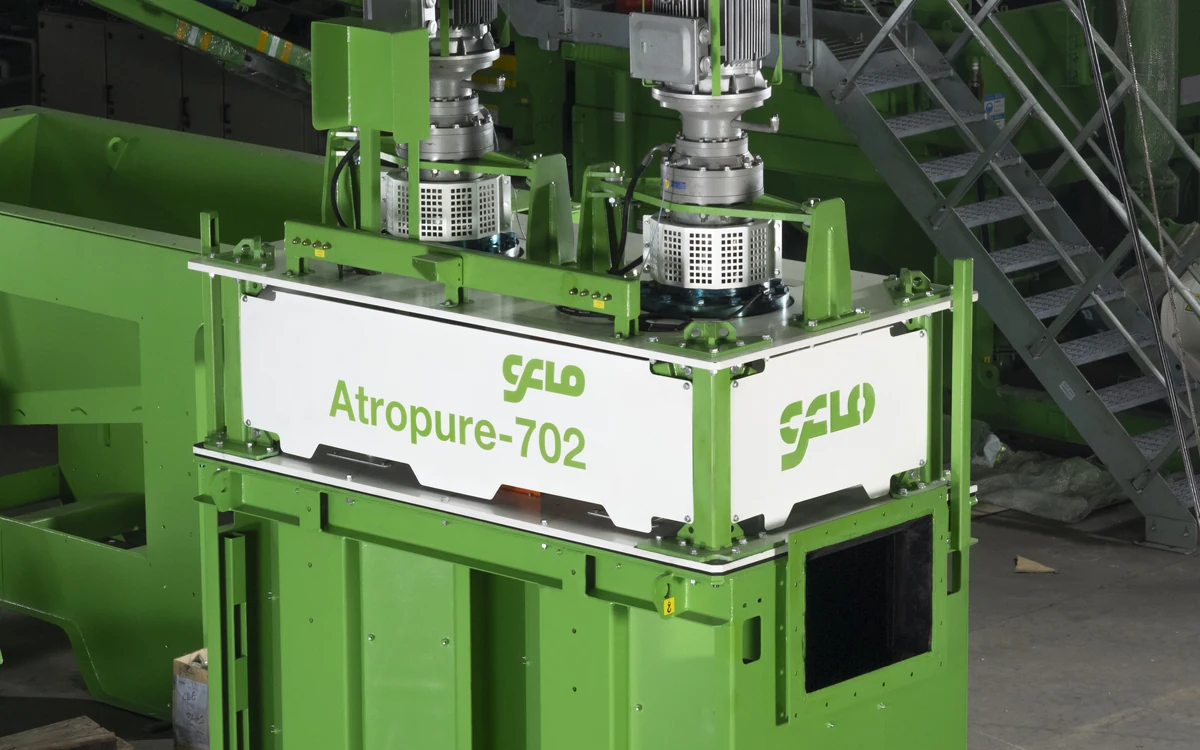
Atropure Attrition Scrubber
Clean surfaces before you separate. Two and four cell units running at up to 80% solids.
The CFlo Atropure is a heavy-duty attrition scrubber that cleans mineral surfaces by driving particles against each other in a dense slurry. Clay, iron oxide films and organic coatings are sheared off so that the separation stages downstream read the mineral itself rather than what is stuck to it. It is built into CFlo beneficiation plants and is also supplied on its own.
What attrition scrubbing is for
Most minerals do not arrive at a separation stage clean. Clay binds to the surface, iron oxide films coat quartz grains, organic matter clings to everything. The particle is saleable; the coating is what fails the specification.
Coated surfaces defeat every separation that follows. A gravity circuit sorts on the density of particle plus coating rather than the mineral. A magnetic separator reads a false signal off a masked grain. Classification sends the wrong fraction downstream because the effective particle size is not the real one. Recovery falls, and no amount of tuning downstream recovers it, because the information the circuit needs was destroyed before it arrived.
Attrition scrubbing removes that layer mechanically. It is not a wash. It is high-energy particle-on-particle contact in a slurry dense enough that grains have nowhere to go but against each other.
Industries this plant serves
Why the slurry has to be thick
An attrition cell does its work through particle-to-particle contact, so the useful energy is whatever gets transferred between grains. Anything dissipated in the water between them is wasted.
Add water and you separate the particles, cushion the contact and spend motor power stirring liquid. The Atropure is built to run at 60 to 80% solids, at the dense end of what an attrition cell can handle, which is why it delivers cleaning energy per tonne that a thinner circuit cannot match at the same installed power.
The impeller does the work
The impeller tree is the machine. Blades sit on multiple tiers at alternating angles rather than in a single plane, so there is no quiet zone in the cell and material is forced through overlapping shear fields across the full cell volume.
Blade tips are a hardened alloy chosen for abrasive mineral slurry, and each blade is bolted to the central shaft rather than welded to it. A worn segment is swapped on site without pulling the assembly, which is the difference between a shift and a shutdown.
Two cells, two drives
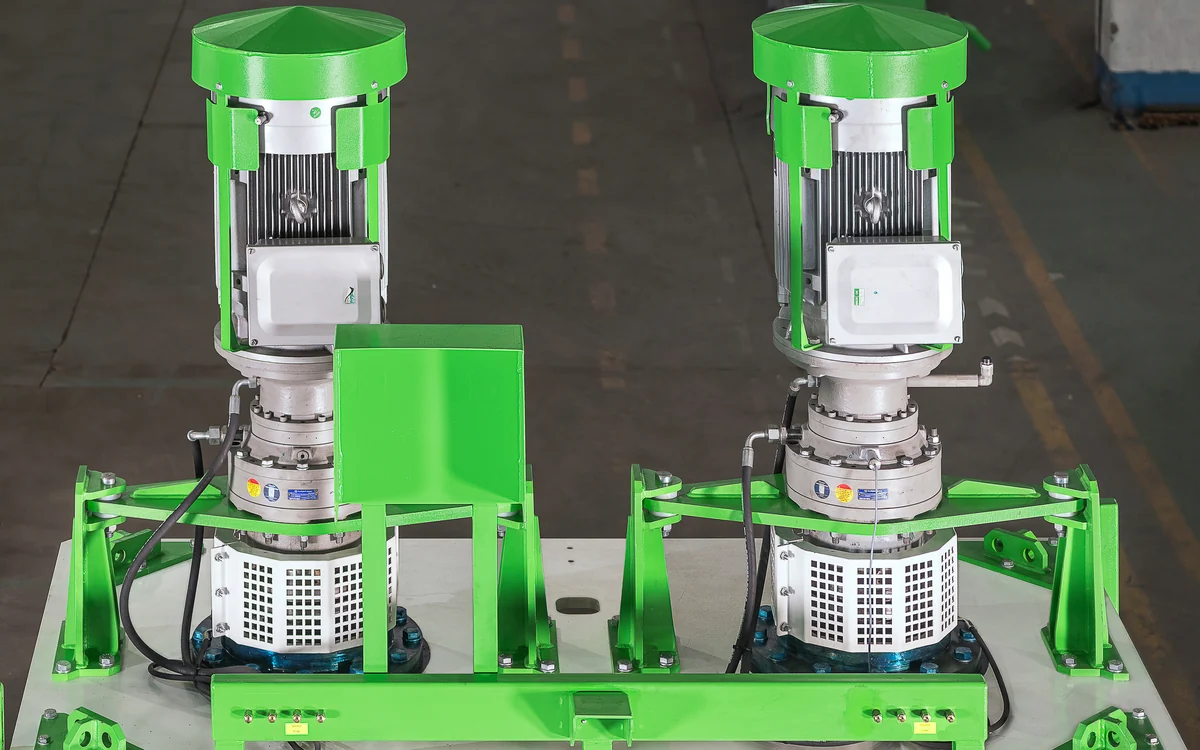
Each cell carries its own motor and gearbox rather than sharing a line shaft. If one drive needs attention the other cell keeps running, so a service visit does not have to stop production entirely.
Lubrication is by circulating oil rather than grease. Attrition duty is continuous high load, and oil carries heat away from the bearings instead of letting it accumulate, which is what determines how long those bearings last. Motors mount vertically on top of the cells, keeping the footprint tight and removing lateral belts and external gearbox stands from the layout.
Built to be looked into
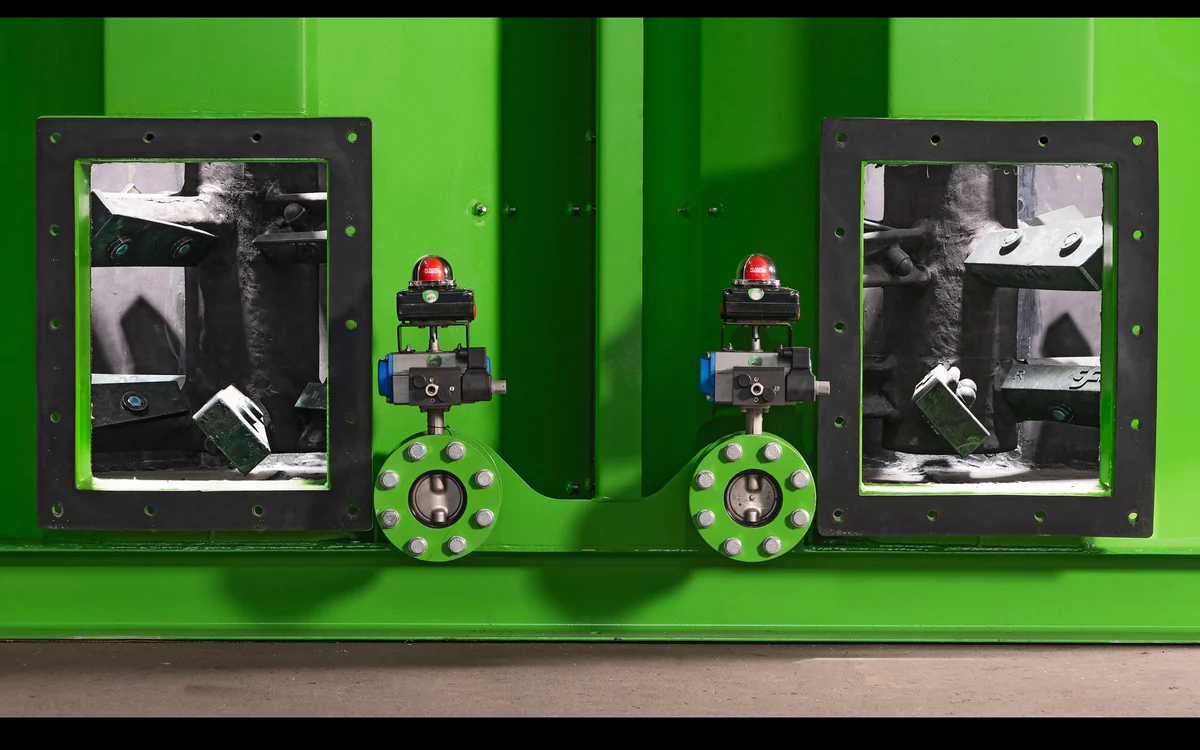
Attrition scrubbers are usually sealed boxes: you learn what is happening inside when performance drops or something breaks. The Atropure carries tempered glass inspection windows, so impeller condition can be checked without lifting the top section.
Cell-to-cell transfer and discharge run through pneumatically actuated butterfly valves with position indicators, which is what makes retention time an adjustable process variable rather than a fixed consequence of the plumbing. Discharge ports are standard flanged connections, so downstream pipework bolts up without field welding or custom adapters.
Every wear component is reachable from ground level. Both cell faces open fully on hinges, exposing the impeller, liners and discharge area with no confined space entry, and liner panels are individually bolted so a single worn panel can be changed without disturbing the ones beside it.
Where it fits in the circuit
The Atropure sits after crushing and desliming and before the separation stages, taking a feed below 5 mm. It is a standard part of CFlo Oremax beneficiation plants and Micrograder industrial sand plants, and is supplied as a standalone unit for existing circuits.
It earns its place wherever surface contamination, rather than grade, is what fails the product: iron ore where clay masks the ore, silica and glass sand where iron oxide films drive the Fe2O3 figure that decides the price, chromite, quartz and foundry sand.
Model range
| Parameter | Atropure 702 | Atropure 704 |
|---|---|---|
| Cells | 2 | 4 |
| Typical feed size | Below 5 mm | Below 5 mm |
| Throughput (solids) | 70 tph | 70 tph |
| Operating solids density | 60–80% | 60–80% |
| Installed power | 62 kW | 124 kW |
| Water requirement | 20–25 m³/hr | 20–25 m³/hr |
| Lubrication | Oil-cooled | Oil-cooled |
| Length | 2,700 mm | 5,150 mm |
| Width | 1,540 mm | 1,540 mm |
| Height | 4,420 mm | 4,420 mm |
Cell count is set by how much scrubbing the material needs, not by tonnage. Stubborn coatings and tightly bound clays want the longer retention of the four-cell machine; lightly contaminated feed is clean after two.
In pictures
Frequently asked questions
What is an attrition scrubber?
A machine that cleans mineral surfaces by high-energy particle-on-particle contact in a dense slurry. It does not reduce particle size in any meaningful way. It removes what is stuck to the outside of the grain so that the separation stages downstream can read the mineral correctly.
Attrition scrubbing or a logwasher: which do I need?
They work at opposite ends of the size range and often appear in the same plant. A Scrubmax logwasher handles coarse aggregate up to around 100 mm and strips heavy clay and organics by stone-on-stone action. The Atropure works on material below 5 mm, where the contamination is a film on the grain rather than a lump of clay between stones. Send us a sample and we will tell you which stage your material actually needs.
Will it break my particles?
It is designed not to. The energy goes into surface shear rather than impact, and the impeller geometry is set up for scrubbing rather than grinding. Some degradation of already friable material is unavoidable in any attrition cell, which is one of the things a pilot test on your own sample establishes before a machine is specified.
How much water does it need?
20 to 25 m³/hr, and in a CFlo plant that water is recycled by the Hydromax circuit rather than drawn fresh.
Can it be retrofitted to an existing plant?
Yes. The Atropure is supplied as a standalone unit with flanged connections and is designed to be inserted into an existing circuit ahead of the separation stages.
How do I know whether my material needs attrition?
Compare a bench separation on your feed as received against the same separation after scrubbing. Where surface contamination is the constraint the difference is unmistakable. That comparison is part of the standard pilot work at our test facility, on your own material rather than a catalogue equivalent.