
CFlo in the UK and Ireland
Concreting sand and recycled aggregate made where the material is, supported from Belfast, and sized on a study of your own sample.
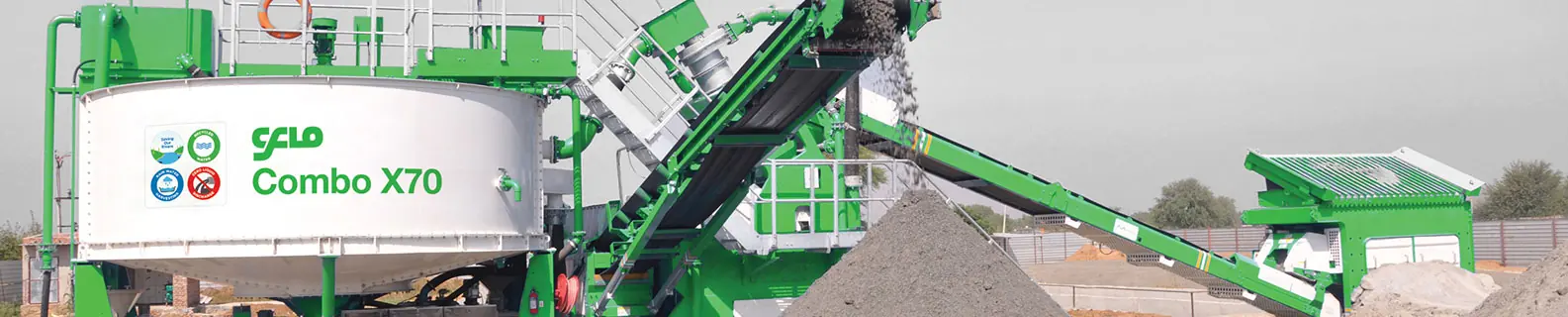
CFlo builds modular wet processing plants that turn quarry by-product, as-dug sand and gravel, industrial sand deposits and construction and demolition waste into a specification product: concreting sand to BS EN 12620, graded aggregate to BS EN 13242, glass, foundry and filtration sand, and washed recycled sand and aggregate. In the United Kingdom and Ireland the plants are sold, installed and supported by CFlo Europe Limited from Belfast and are CE and UKCA marked, and every project is sized on a Sample Study of the operator's own material at CFlo's pilot plant and laboratory in India before anything is designed. CFLO is a registered trade mark in the United Kingdom (UK00003977524) and the European Union (EUTM 018951318), and the Combo sand washing plant is protected by granted UK patent GB 2552042 B and by registered designs in the United Kingdom (90025315660002) and the European Union (002531566-0002).
What CFlo builds
Five platforms cover the range. Each is a factory-assembled modular plant that ships in standard containers and commissions on a prepared pad rather than being built up on site. Three of them have pages written for UK feeds, standards and site conditions, which apply equally on Irish sites.
- Combo for UK and Irish quarries: the sand washing plant, taking crushed rock fines, quarry scalpings or as-dug sand and gravel to washed concreting sand and clean graded aggregate at up to 350 tonnes per hour on one chassis, with up to 95% of process water recycled.
- Micrograder for silica sand, china clay and foundry sand: the specification plant for the precision end of the market, grading to a narrow band with attrition scrubbing, precision fine screens, spiral gravity concentrators and upward-flow classification, and recovering the by-product sand as a saleable product.
- Reurban for construction and demolition waste: the modular plant that washes rubble, excavation spoil, incinerated bottom ash and clay-bound quarry by-product into washed recycled sand and graded aggregate, with wood, plastic and other lightweights removed.
- Oremax: the ore washing and beneficiation plant, proven on iron ore, limestone, chromite, quartz, bauxite, phosphate and manganese, and on slimes recovered from tailings.
- Aerograder: the dry air classifier, cutting fines from a dry feed below 5 mm with no process water, no cyclones and no baghouse.
Two process modules come with every wet plant as standard. The Hydromax high-rate thickener returns the great majority of the process water to the plant, and the Easysettle sludge bay manager rigidifies tailings at the point of disposal so they release their water at once and dry to a trafficable cake, which keeps the lagoon footprint small; where a site has no room for lagoons, mechanical dewatering is specified instead. Plants for the United Kingdom and Ireland are CE and UKCA marked, including the PLC control panels CFlo designs and builds itself. The Combo is patented in the United Kingdom (GB 2552042 B) and its design is registered in the United Kingdom and the European Union.
Concreting sand from the fines a quarry already has
UK and Irish quarries have two feeds for a wash plant: the fines a crushed rock quarry produces anyway, which leave the site cheaply as scalpings or sit in a stockpile, and as-dug sand and gravel carrying clay and silt. The Combo handles both. The plant takes the minus 63 micron fraction out under control, at a cut point the operator sets, scrubs off clay where it is present, and grades what is left to sit inside the BS EN 12620 envelope for concreting sand, with the coarse fractions sold as graded aggregate to BS EN 13242 from the same plant. Wing stockpiling conveyors let one plant send a concreting sand and a finer building sand to two stockpiles at once.
New permissions are not keeping pace with what is used. Across 2014 to 2023, for every 100 tonnes of sand and gravel used in Great Britain, new planning permissions were granted for about 61 tonnes, and for crushed rock about 33 tonnes, figures the Mineral Products Association has said are not sustainable in the medium term. Concreting sand travels a long way by road to reach sites that are sitting on a quarry. A crushed rock quarry that washes its own fines produces sand where the demand is, from material it has already drilled, blasted and crushed. Whether a given feed gets fully inside the envelope depends on the rock and the crusher setting, which is what the Sample Study establishes. Washing unsold fines into a saleable sand brings them into charge under the Aggregates Levy, at £2.16 a tonne from 1 April 2026, with Scotland's devolved Scottish Aggregates Tax from the same date, so the case rests on the gap between a by-product price and a specification sand price rather than on tax. The UK Combo page covers the specification, the nine models and the water balance.
Silica sand, china clay and foundry sand
Glass sand, foundry sand, filtration media and china clay are a specification discipline rather than a washing job: the product has to land inside a narrow grading band with iron and the fine fraction under control. The Micrograder does that with attrition scrubbing to lift coatings off the grain, precision fine screens to hold the top of the gradation, spiral gravity concentrators to take out heavy minerals and iron-bearing grains without reagents, and upward-flow classification to place the fine cut. At Chu Lai in Vietnam two Micrograder lines take a feed of about 98.5% silicon dioxide to float glass sand above 99.3%, with iron oxide cut from roughly 0.5% to below 0.05%, on an entirely gravity-based circuit with roughly 95% water recovery. The same plant recovers, as a saleable product, the sand that a china clay or industrial sand operation would otherwise send to waste. At Bhuj in Gujarat a Micrograder raised china clay recovery fivefold for Suraj Minerals and made glass-grade sand from the by-product.
Recycled aggregate from construction and demolition waste
Unwashed recycled aggregate usually ends up as fill and sub-base. Washing is what lifts it to a graded aggregate and a recycled sand that a concrete plant will accept, evidenced against BS EN 12620 or BS EN 13242 rather than sold on a description. The Reurban scrubs rubble, excavation spoil and incinerated bottom ash, floats off wood, plastic and paper, takes the fines out under control and grades what is left into washed recycled sand and aggregate, with the contaminants concentrated into a small dewatered residue rather than spread through the product. For a contractor or a recycler the plant turns a disposal cost into a product that sells against primary material, and it is mobile enough to work on the site that generates the waste.
Ireland
CFlo Europe Limited covers the whole island from Belfast, so an operator in the Republic of Ireland deals with the same engineers as one in Northern Ireland or Great Britain, and the whole island is within a day's drive of Belfast. Irish concrete and aggregate specifications sit on the same European standards, I.S. EN 12620 and I.S. EN 13242, and plants for the Republic are CE marked for the European Union. The feeds are familiar too: where the feed is as-dug sand and gravel, the Combo takes it with clay and silt through it to washed concreting sand and clean graded stone as separate products, and on a crushed rock site it washes the fines the crusher already makes. The EU trade mark and the EU registered design cover the Republic.
Trade associations and exhibitions
CFlo Europe Limited is a member of WATA, the Washed Aggregates Trade Association, the UK trade body for washed aggregate. CFlo is a Net Zero Value Chain Partner of the Global Cement and Concrete Association, the London-headquartered body behind the industry's 2050 net zero roadmap, which places the equipment supplier inside the same decarbonisation framework as the concrete producers it sells to. CFlo exhibited at Hillhead 2026 at Buxton, the UK's largest quarrying, construction and recycling exhibition, and Aggregates Business reported on the European expansion in August 2026.
Start with a sample
No plant is engineered from a catalogue. Sizing starts with a Sample Study of your own material at CFlo's pilot plant and laboratory at Howrah, a DSIR-recognised in-house R&D unit: usually a review of your existing gradation data, then a 20 kg bench sample by courier, and a pilot sample only if the bench result justifies it. The report gives grades and yields against the standard the product will be sold on, BS EN 12620 or BS EN 13242, with washed sand also run in concrete. On a UK or Irish site the part that saves the programme is Pre-Engineering: planning and permitting take as long as they take, and the plant is designed while they run, so manufacture starts the day consent lands. The Sample Study page sets out the programme, the timings and how samples travel. Where capital is the constraint, CFlo also offers equipment leasing or pay-per-tonne tolling.
Send us a sample
Tell us about the material and an engineer will come back with how much to send, how to sample it, and what the programme would cover.
Who you deal with in the UK and Ireland
Support is the first question with any imported plant, and for the United Kingdom and Ireland the answer is in Belfast. CFlo Europe Limited, at Donegall House, 7 Donegall Square North, Belfast BT1 5GB, on +44 78687 88960 and [email protected], handles sales, installation, commissioning and support for both countries. The same team manages CFlo's delivery in North America and Oceania, so a UK or Irish project is run by the people delivering CFlo's first Australian frac sand plant. The contact page lists every regional office.

A career spent building wet processing plant for quarries in Britain and Ireland, having previously helped build a global wet processing brand.

What to send us first
A representative sample or a recent gradation of the feed, its clay and silt content, the moisture as it arrives, the specification the product has to meet, the tonnes per hour you want to produce and how much water the site has. If you already sell scalpings or as-dug material, the price you get for it is useful too, because it is the number the washed product has to beat. Send it through the form above or contact CFlo Europe Limited, and we will scope the Sample Study with you before you ship anything.
Frequently asked questions
Does CFlo supply plants in the United Kingdom and Ireland?
Yes. CFlo Europe Limited in Belfast sells, installs and supports CFlo plants across the United Kingdom and Ireland, on +44 78687 88960 and [email protected]. Plants are CE and UKCA marked, and CFlo Europe Limited is a member of the Washed Aggregates Trade Association.
Can the Combo make concreting sand to BS EN 12620 from crushed rock fines?
It is the duty UK quarries most often buy it for. The Combo washes the crusher fines, takes the minus 63 micron fraction out at a set cut point and grades the rest to sit inside the concreting sand envelope, with the coarse fractions sold to BS EN 13242. How far a particular rock gets inside BS EN 12620 depends on the crusher setting as much as on the plant, which is what the Sample Study tests before anything is quoted.
Is CFlo's equipment protected in the UK and the EU?
CFLO is a registered trade mark in the United Kingdom (UK00003977524) and the European Union (EUTM 018951318). The Combo sand washing plant is protected by granted UK patent GB 2552042 B and by registered designs in the United Kingdom (90025315660002) and the European Union (002531566-0002), alongside granted patents in the United States, Canada and Australia.
How does a Sample Study work from the UK or Ireland?
Programmes are sized in bulk from 20 kg for a short bench programme up to 2500 kg for a full pilot campaign, depending on the stages involved. Samples travel to the CFlo works at Sankrail Industrial Park, Howrah, India, on a DDP basis with the paperwork agreed first. How the sample is taken matters as much as how much is sent, so the scoping conversation with Belfast comes before anything ships.
Who supports a CFlo plant once it is running?
CFlo Europe Limited in Belfast installs and commissions the plant and is the first call for service across the United Kingdom and Ireland. Plants ship with the PLC control panel CFlo designs and builds itself.