
Sand Washing Plants for United States and Canadian Quarries
Concrete sand made from the crusher fines a quarry already produces, rather than natural sand trucked in from further away each year.
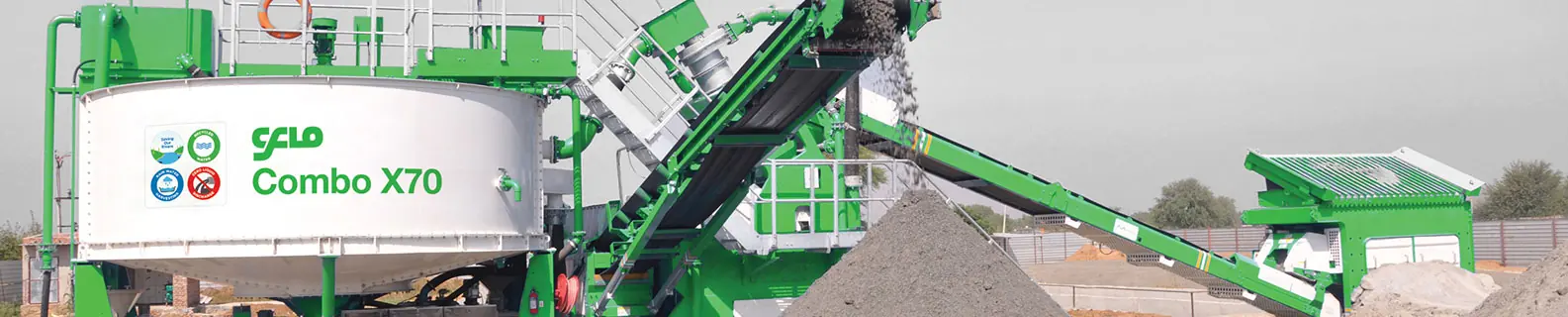
The Combo is a modular sand washing plant that turns crusher fines, screenings and pit-run sand and gravel into washed concrete sand and clean graded aggregate, at up to 350 tonnes an hour (about 385 US tons) on one chassis and more where units are combined. It removes the minus 75 micron fraction, the minus 200 mesh, at a cut point set to the specification, recycles up to 95% of its process water and is supplied with a UL-listed control panel for the United States or a CSA-certified one for Canada. Sales and support are handled by CFlo North America, with delivery managed by CFlo Europe Limited.
The feed a North American quarry already has
Every hard rock quarry produces sand-sized material as a by-product of crushing. The sub-5 mm fraction left when rock is crushed is called crusher fines, screenings or stone dust depending on the state or province, and crushed rock fines or quarry fines in Britain and Ireland. The names describe the same material everywhere: too dusty and too poorly graded to sell as sand, so it stockpiles at the crusher or goes out as low-value fill.
Washing is what turns it into a product. A Combo takes the minus 75 micron fraction out, typically 15–20% of the feed or a little more, scrubs off any clay, and grades what is left into concrete sand. The lean 75 to 600 micron fraction, the range where crusher fines are most deficient and every particle counts, is kept in the product rather than lost with the fines.
The same chassis does the coarse end of the job as well. On a quarry with screen oversize or reject stone, it scrubs, screens and rinses the silt and clay off the aggregate, so one plant can send a graded aggregate and a specification sand to the stockpile from a single feed.
Why the move to manufactured sand
Natural sand within economic trucking distance of the major metropolitan markets is becoming harder to find. Deposits close to the cities are worked out or constrained by permitting, and the deposits that replace them are further from where concrete is poured. Freight is charged by the ton over every mile, so the delivered cost of natural sand rises each time the source moves further out.
Manufactured sand from crushed rock is the response. The hard rock quarries that already supply coarse aggregate to the cities produce crusher fines as a matter of course, from material that has already been drilled, blasted and crushed. Washing it into concrete sand produces the sand where the demand is, and the hauling avoided counts commercially before it counts environmentally. The same arithmetic applies in Canada wherever permitted natural sand is limited and hard rock is quarried close to the market.
The specification the sand has to meet
Washed sand off a Combo is made to sit inside a grading envelope, not simply to look clean. In the United States, concrete sand is sold against ASTM C33 or AASHTO M 6 and, for public works, the state department of transportation specification, each with its own requirements for grading, fineness modulus, minus 200 mesh content and deleterious material. In Canada the reference is CSA A23.1, with provincial specifications alongside.
The fine end is where a plant holds the specification or does not. The minus 200 mesh fraction has to come out under control, at a cut point the operator sets, not wherever the water happens to take it. On a Combo the Screenmax FS86 high precision fines screen holds the top of the gradation and dewaters the product on the same deck, and the Vertimax upward flow classifier (a hydraulic, teeter-bed classifier) trims the excess fines that crusher fines always carry, bringing the sand inside the envelope rather than leaving it just outside.
Wing stockpiling conveyors controlled by a hydraulic cylinder let one plant send two sand products to two stockpiles at once, so a quarry can sell a concrete sand and a finer mason or plaster sand from the same feed. The Centriscreen dewatering and sizing system delivers both ready for market straight from the belts.
Clause-by-clause compliance is a matter for the Sample Study, which reports the washed sand against the specification your customer actually names, using that standard's own test methods, so the result can be read directly against what the sand will be sold on.
The Combo in figures
Nine models cover the range up to 350 tonnes an hour on a single chassis, and capacity beyond that comes from combining units rather than moving to a larger machine. The X series is single wash; the Alpha, Turbo, Multi and Mega are dual wash. Each plant is custom built for its feed, so the scrubbing intensity, the cut points and the dewatering are set by the material rather than by a catalog.
| Model | Throughput (metric tonnes an hour) | About (US tons an hour) | Wash |
|---|---|---|---|
| Combo X50 | 45 to 50 | 50 to 55 | Single |
| Combo X70 | 70 to 100 | 75 to 110 | Single |
| Combo Turbo D90 | 80 to 90 | 90 to 100 | Dual |
| Combo Alpha | 100 to 120 | 110 to 130 | Dual |
| Combo Multi E5 | 100 to 200 | 110 to 220 | Dual |
| Combo X120 | 120 to 140 | 130 to 155 | Single |
| Combo X150 | 150 to 180 | 165 to 200 | Single |
| Combo X220 | 220 to 250 | 240 to 275 | Single |
| Combo Mega E5 | 200 to 350 | 220 to 385 | Dual |
Standard capacity varies with feed gradation, clay content and moisture, which is why sizing follows a sample rather than a table.
All seven functions of wet processing sit on the one patented chassis: feeding, screening, classification, dewatering, water recovery, sludge handling and stockpiling. The plant ships in standard containers, lands on simple pads without anchoring and runs at under 80 dB. The control panel is built by CFlo as an accredited panel builder, housed in a double door stainless steel enclosure for harsh outdoor conditions, with a touch screen PLC as standard. Walkways are to the same specification as a static plant. CFlo holds the granted United States and Canadian patents on the Combo (US 11,185,869 B2 and CA 3,046,045 C), and plants for North America are supplied with UL-listed control panels for the United States and CSA-certified panels for Canada.
Water: up to 95% recycled
The Combo recycles up to 95% of its process water on the same chassis, and the installation runs with zero liquid discharge. On a North American quarry that bears on the water permit, on what a settling pond costs in land you could otherwise be quarrying, and on whether the plant keeps running through a dry year or a drought restriction.
The Hydromax thickener recovers the water and the Easysettle sludge bay manager rigidifies the tailings at the point of disposal, so they dry to a trafficable cake without a pond. The fines that come out are a product in their own right where there is a market for them, in brick-making, cementitious blends and fill.
Winter and the site
Wash plants in Canada and the northern states commonly run seasonally, from spring to late autumn, with sales fed from the washed stockpile through the winter. Whether a Combo runs seasonally or is winterised, and what that means for the water circuit, the Hydromax and the Easysettle, is fixed at the Pre-Engineering stage with the site's own engineers, in the general arrangement, the utility schedules and the equipment list. CFlo's operating references are in warm climates, so that scope is engineered for each site rather than copied from a catalog. Because the plant arrives as factory-assembled modules and lands on prepared pads, the on-site work is measured in days, as the ten-day relocation of a Combo at GR Infraprojects in India showed, and it can be moved to a second site later rather than being written off with the first.
The Sample Study comes first
No plant is engineered from a catalog. Sizing starts with a Sample Study at CFlo's own pilot plant and laboratory at Howrah, a DSIR-recognised in-house R&D unit, which runs bench-scale and pilot-scale programs on bulk samples as a connected circuit rather than as jar tests. Programs are sized from 20 kg (45 lb) for a short bench program up to 2500 kg (5,500 lb) for a full pilot campaign, and samples come to the CFlo works at Sankrail Industrial Park, Howrah, India, on a DDP basis with the paperwork agreed first. What comes back is a report: feed characterization, stage-by-stage results, a mass and water balance, product grades and yields against the specification the sand will be sold on, and samples of the products to put in front of your own customer. Pre-Engineering follows only if the numbers work, and runs in parallel with capital approval. The Sample Study and Pre-Engineering page sets out both services in full.
Send us a sample
Tell us about the material and an engineer will come back with how much to send, how to sample it, and what the programme would cover.
Who you deal with in North America
CFlo North America handles sales and support inquiries for the United States and Canada on +1 587 883 2657 or [email protected]. Delivery is managed by CFlo Europe Limited in Belfast, whose territory covers the UK, Europe, North America and Oceania. A Reurban recycling operation is already running in Canada. The North America page sets out the full range, the frac sand and silica sand page covers the Micrograder and Aerograder, and the contact page lists every regional office.

A career spent building wet processing plant for quarries in Britain and Ireland, having previously helped build a global wet processing brand.
What to send us first
A representative sample or a recent gradation of the crusher fines, the clay content if you know it, the specification the sand has to meet, the tons per hour you want to produce, and how much water the site has. If natural sand is currently being trucked in, the delivered cost per ton is useful too, because it is the number a washed manufactured sand has to beat. Send it through the form above, or contact CFlo North America, and we will scope the Sample Study with you before you ship anything.
Frequently asked questions
Can crusher fines really be washed into concrete sand?
Yes, where the washed grading sits inside the envelope of ASTM C33 or CSA A23.1 and the state or provincial specification, which is what the Sample Study reports before a plant is sized. The Combo takes out the minus 200 mesh fraction at a set cut point, keeps the lean 75 to 600 micron fraction in the product, and scrubs off clay, so the sand meets the grading and the deleterious material limits rather than only looking clean.
How much water does a Combo use?
Up to 95% of the process water is recycled on the chassis and the installation runs with zero liquid discharge, so the make-up water is a small fraction of the water in circulation. The Hydromax thickener recovers the water and the Easysettle sludge bay manager dries the tailings to a trafficable cake without a pond.
What capacity do the models cover?
From the Combo X50 at 45 to 50 tonnes an hour (about 50 to 55 US tons) to the Combo Mega E5 at 200 to 350 tonnes an hour (about 220 to 385 US tons), with capacity beyond that from combining units. Standard capacity varies with feed gradation, clay content and moisture, which is why sizing follows a sample rather than a table.
Is the plant suitable for a Canadian or northern winter?
Most northern wash plants run seasonally and sell from the washed stockpile through the winter. Whether a Combo runs seasonally or is winterised is fixed at the Pre-Engineering stage with the site's own engineers, and the water circuit, Hydromax and Easysettle are specified accordingly. The modules arrive factory-assembled and land on prepared pads, so on-site work is measured in days.
Who supplies and supports a CFlo plant in the United States and Canada?
CFlo North America handles sales and support on +1 587 883 2657 and [email protected], and delivery is managed by CFlo Europe Limited in Belfast. Control panels are supplied UL listed for the United States and CSA certified for Canada, and plants ship in standard containers. The contact page lists every regional office.
Is the Combo patented in the United States and Canada?
Yes. The Combo sand washing plant is covered by granted patents in both countries, United States patent US 11,185,869 B2 and Canadian patent CA 3,046,045 C, and by the corresponding granted patents in the United Kingdom and Australia. The patents cover the Combo's integrated screening, hydrocyclone classification and closed-loop water recycling arrangement on one chassis. CFLO is also a registered trademark in the United States (Reg. No. 7,630,688, Class 7).