
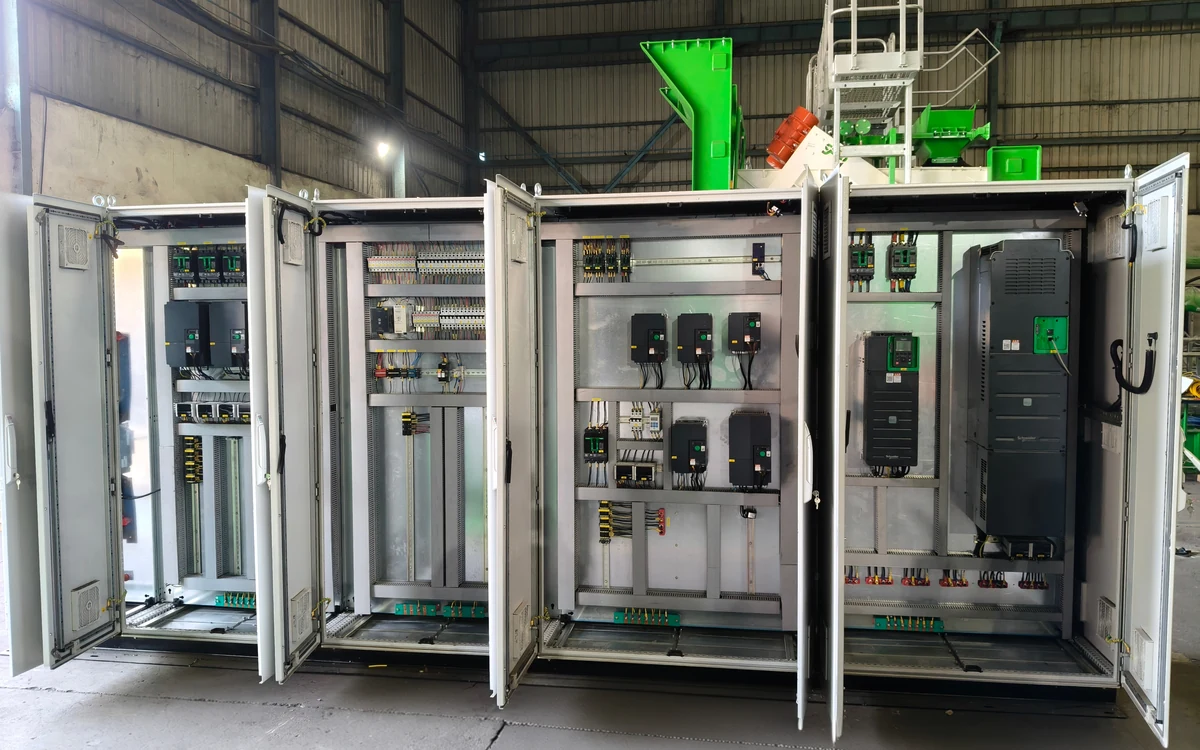
PLC Control Panel
A plant is only as dependable as the panel driving it.
Every CFlo plant is run by a PLC control panel that CFlo designs, builds and tests in its own works rather than buying in. Panels are built to CE, UKCA, CSA and AS/NZS requirements, by an accredited panel builder within the partner programme of one of the world's largest electrical equipment manufacturers. They arrive pre-wired and factory tested, so commissioning is a matter of energising the plant rather than wiring it.
What the panel actually does
It is easy to think of a wash plant as steel: the screens, the scrubbers, the thickener. In practice, almost nothing on a modern plant happens without the panel telling it to.
Every start and stop sequence runs from the panel, in the order that protects the plant: conveyors before feeders, water before material, and the reverse on shutdown. Every interlock lives there, so a blocked chute stops the feed rather than burying a conveyor, and a high sludge level trips the plant rather than overflowing a tank. Every variable speed drive takes its setpoint from it, which is how feed rate becomes a number an operator chooses rather than a consequence of how the loader is working. Every figure on the HMI comes from it, and so does every alarm and the event log behind them.
Get the mechanical design right and the panel wrong, and you have a plant that works when watched.
Built here, not bought in
CFlo builds its own panels. That is a deliberate choice and an expensive one, and the reason is accountability.
A plant assembled from someone else's control panel has a seam in it. The mechanical supplier blames the controls, the controls supplier blames the mechanical design, and the customer sits between them holding a plant that does not run. Building the panel in the same works as the plant removes that seam: the people who designed the sequence are the people who wired it, and one organisation answers for whether it works.
It also means the panel is designed around this plant rather than adapted to it. Drive sizes, interlocks, spare ways and cable schedules follow the flowsheet.
Certified to four regimes
Panels are built to CE for Europe, UKCA for the United Kingdom, CSA for North America and AS/NZS for Australia and New Zealand.
That matters more for a control panel than for most of the plant, because the panel is where the electrical safety case actually lives: clearances and creepage, short circuit withstand, protective earthing, ingress protection, thermal design, and the labelling and documentation an inspector will ask for. A plant can be mechanically excellent and still fail an inspection on its panel.
CFlo is also an accredited panel builder within the partner programme of one of the world's largest electrical equipment manufacturers. That accreditation is an audit of how the panel is designed, built and tested, not simply a note about whose components are inside it: it covers the build standard, the test regime and the competence of the people doing the work.
What is inside
A CFlo panel is a motor control centre and a process controller in one enclosure line-up.
The PLC and its I/O run the sequences and the interlocks. Variable frequency drives take the larger motors, giving soft starts that spare belts and gearboxes, and speed control where the process wants it. Protective devices, contactors and isolators handle switching and fault clearance. Terminal rails land every field cable on numbered terminals that match the drawings, which is the difference between a fault found in ten minutes and one found in a day. Forced ventilation keeps the enclosure inside its thermal rating, because drives derate when they get hot and fail when they stay hot.
Cubicles are laid out so that a fitter can work: doors that open fully, gear grouped by function, and room left for the ways a plant is likely to gain later.
Pre-wired and factory tested
The panel is wired and tested in the works before it ships, not on your site in the weather.
Every circuit is proven, every drive parameterised, every sequence stepped through and every interlock deliberately tripped to confirm it does what the drawing says. What arrives is a panel that has already been made to work once, so commissioning is a matter of energising the plant and tuning it rather than discovering it.
Documentation ships with it: schematics that match the terminals, a functional description, drive parameter records and the certification file.
Remote support
Because the plant is PLC controlled and instrumented, it can be supported remotely through Cloudlink, which is how an engineer can look at what a plant is actually doing before anyone gets on a plane.
Where it fits
Every CFlo plant has one: Combo, Micrograder, Oremax, Reurban and Aerograder, along with the ancillary systems that run their own sequences, including Hydromax, Easysettle and Vertimax, whose bed control loop is a good example of what the panel is really for.
Panels are also built for plants CFlo did not supply, where an operator wants the controls on an existing circuit brought up to a current standard.

Frequently asked questions
Why does CFlo build its own control panels?
Accountability. A plant with a bought-in panel has a seam between the mechanical supplier and the controls supplier, and that seam is where a plant that does not run gets argued about. Building both in the same works means one organisation answers for the result.
What certifications do the panels carry?
CE, UKCA, CSA and AS/NZS, so a plant can be supplied into Europe, the UK, North America and Australasia without the panel being the thing that holds it up.
What does accredited panel builder mean?
That the works has been audited by a major electrical manufacturer against its own standards for how panels are designed, built and tested, and is approved to build to them. It is a statement about process and competence rather than about which components are fitted.
Is the panel tested before it arrives?
Yes, fully. Circuits proven, drives parameterised, sequences stepped through and interlocks deliberately tripped, in the works. Commissioning on site is then tuning rather than fault-finding.
Can you supply a panel for a plant you did not build?
Yes. Panels are built for existing circuits, typically where an operator wants the controls brought up to a current standard or needs a certification the original panel cannot support.
Can the plant be supported remotely?
Yes, through Cloudlink. Being PLC controlled and instrumented is what makes that possible: an engineer can see what the plant is doing rather than relying on a description of it.