
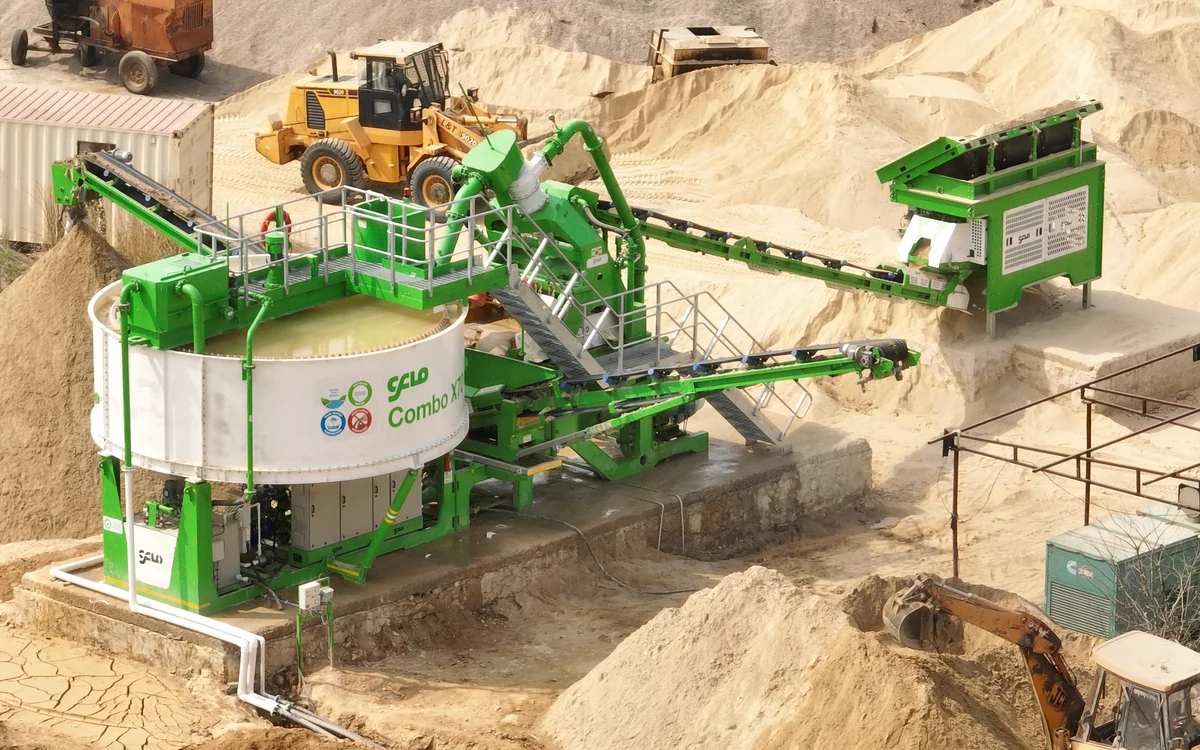
Wash Plants
Washing, grading, dewatering and water treatment engineered as one plant, not assembled from parts on site.
A wash plant is the machinery that takes a dirty feed and turns it into washed material: it scrubs off clay and silt, grades the material into products, dewaters them for stockpiling, and treats the water so it can be used again. CFlo builds wash plants as single modular chassis with the water treatment already inside them, delivered pre-wired and factory tested, so what arrives on site is a working plant rather than a set of machines to be integrated.
What a wash plant has to do
Washing is only part of the job. Four operations have to work together, and a plant that performs three of them well will still be limited by the fourth.
It has to scrub, because plastic clay bonded onto stone will not come off under a spray bar. It has to grade, holding every product inside its band while the feed changes through the day. It has to dewater, because sand stockpiled too wet drains across the yard and takes its finest and most valuable fraction with it. And it has to deal with the water, because the silt has to go somewhere and fresh water is the input a site is most likely to be refused.
Water handling is the operation most often left outside the plant's scope, and it is frequently the one that determines whether a site is granted permission.
Integrated water treatment, not a separate project
Water treatment bolted on afterwards is a second project with its own footprint, its own civils and its own supplier. Building it into the plant instead changes the arithmetic on site: around 95% of process water is recovered and returned, the solids leave as a handleable filter cake rather than filling settling ponds, and the fresh water top-up drops to what evaporation and the moisture in the product take away.
For C&D recycling in particular, this is why modular C&D plants with integrated water treatment have displaced the older approach. An urban recycling site rarely has room for lagoons, and rarely has a water allocation to waste.
A filter press is what makes this practical. Settling alone leaves a pond to manage. A press takes the thickener underflow and produces a stackable cake that can be loaded and moved, so the fines become a material the site can dispose of or sell. It is specified as part of the plant rather than offered as an upgrade.
Most of this sits in the mid-size modular band. Independent recyclers and regional producers are generally buying a plant with full water management rather than commissioning a one-off mega-project, and that is what the modular format is built for. Our installed C&D plants run from around 120 tph upward, including Metrro Waste at 120 tph in Thane and QPMC at 310 tph in Qatar.
Plug-and-play delivery
Our plants ship in a plug-and-play format: the modules arrive pre-wired, pre-plumbed and factory tested, and are bolted rather than site-welded onto a prepared base. This has three commercial consequences.
Commissioning takes days rather than months, so the plant begins earning sooner. Civil works are a fraction of those required by a site-built plant, since there is no raft to pour for machines not designed to sit together. And when a pit works out or a contract moves, the plant can be relocated rather than rebuilt.
Which plant for which feed
The appropriate plant depends on the feed material. The platforms are arranged around feed type rather than capacity alone.
-
Combo for washed sand from natural deposits and crushed rock fines: feeding, washing, grading, classification and dewatering on one chassis.
-
Reurban for construction, demolition and excavation waste, where the contaminants are varied and lightweights have to be taken out.
-
Oremax for upgrading low-grade ore and treating tailings.
-
Micrograder for high specification silica, glass, foundry and frac sand, where the grading tolerance is tight.
-
Aerograder where there is no water to use at all, classifying dry in an enclosed circuit.
Ancillary units, from scrubbers to water treatment, are engineered into the same chassis rather than sourced separately. See all processing plants.
Sizing a plant
A plant sized from a catalogue is sized against someone else's material. The design is determined by the feed: its clay content, how it varies across the deposit, the top size, and the specification the product has to meet.
We pilot the material at our material testing lab and use the measured results in the proposal. Quoting this way takes longer, but the plant reaches the stated tonnage sooner.
Frequently asked questions
What is a wash plant?
A wash plant is a system that washes, grades and dewaters aggregate or sand, removing clay, silt and dust so the material meets a specification. A complete plant also treats the process water so it can be recycled rather than discharged.
What is the difference between a wash plant and a screening plant?
A screening plant separates by size only. A wash plant uses water to remove the clay, silt and dust coating the particles as well, which is what a fines limit in a concrete specification measures. Dry screening cannot pass material that a wet plant can.
Do I need a separate water treatment plant?
Not with these. Water treatment is engineered into the same modular chassis, recovering around 95% of process water and producing a handleable filter cake instead of requiring settling lagoons.
What does plug-and-play mean for a wash plant?
The modules arrive pre-wired, pre-plumbed and factory tested, and bolt onto a prepared base rather than being welded together on site. Commissioning takes days rather than months, civil works are minimal, and the plant can be relocated later without a rebuild.
Can a wash plant be moved once the site works out?
Yes. The plants are modular and bolted rather than site-welded onto a concrete raft, so relocating within a deposit, or to a new contract, is a planned move rather than a reconstruction.
How much water does a wash plant use?
Far less than the throughput suggests, because the circuit is closed. Around 95% of process water is recovered and returned, so the fresh water requirement is the top-up for evaporation and for the moisture retained in the finished product.