
Combo Washing Plant for UK Quarries
Making concreting sand at the quarry that produces the rock, instead of hauling it across the country.
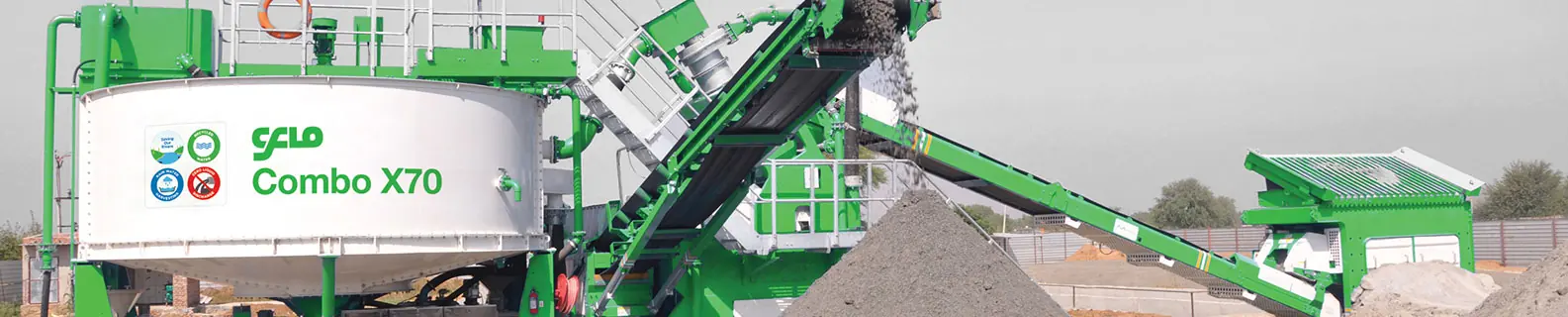
The Combo is a modular washing plant that turns crushed rock fines, quarry scalpings and as-dug sand and gravel into washed concreting sand and clean graded aggregate, at up to 350 tonnes per hour on one chassis and more where units are combined. It recycles up to 95% of its process water. In the United Kingdom it is supplied and supported by CFlo Europe Limited in Belfast.
The two feeds a UK quarry actually has
British primary aggregate divides into crushed rock and sand and gravel, and the Combo is built for both. On a crushed rock site the feed is the fines the crusher makes anyway, sold cheaply as scalpings or stockpiled because nothing will take it. On a sand and gravel site the feed is the as-dug material, arriving with clay and silt through it.
Either way the plant does the same job: it takes the dirt and the ultrafine fraction out, and sends washed sand and clean graded stone to the stockpile as separate products.
Why this matters more in Britain than it used to
Britain is not replacing what it digs. Across 2014 to 2023, for every 100 tonnes of sand and gravel used in Great Britain, new planning permissions were granted for about 61 tonnes. For crushed rock the figure is about 33 tonnes. The Mineral Products Association, which publishes those numbers, has said plainly that this is not sustainable in the medium term.
Crushed rock is still the material Britain has most of, and half of national aggregate supply comes from it. Sand and gravel is the scarcer half of the problem, and it is the fraction that has to be washed before it can go into concrete. The result is concreting sand travelling a long way by road to reach sites that are sitting on a quarry.
A crushed rock quarry that washes its own fines produces sand where the demand is, from material it has already drilled, blasted and crushed. The saving is commercial before it is environmental, though the haulage avoided counts on both.
The specification the product has to meet
Washed sand off the Combo is made to sit inside a grading envelope rather than simply to look clean. For concrete that means BS EN 12620, and the fine end is where a plant either holds the specification or does not: the minus 63 micron fraction has to come out under control, at a cut point the operator sets, not wherever the water happens to take it.
The coarse products are graded to the sizes the market buys, for concrete or as unbound and hydraulically bound mixtures to BS EN 13242 for sub-base and capping. Wing stockpiling conveyors controlled by a hydraulic cylinder let one plant send two sand products to two stockpiles at once, so a site can sell a concreting sand and a finer grade from the same feed.
In British terms that means concreting sand washed to concrete grade, building sand for mortar and render, asphalting sand for coated macadam, and screened and graded stone in the sizes the market takes. Where the feed is crushed rock fines rather than a natural deposit, the washed sand is also sold as spec sand or manufactured sand. Material sold on without washing is as-dug, and goes to fill.
Water, tailings and the space they take up
The Combo recycles up to 95% of its process water, which on a UK site is less about scarcity than about consent conditions, abstraction licensing and what a settling lagoon costs in land you could otherwise be quarrying.
The Easysettle sludge bay manager rigidifies tailings at the point of disposal so water is released from the slurry immediately. Tailings dry faster, the lagoon footprint shrinks and recycled water is back in the plant sooner. Where a site has no room for lagoons at all, the plant can be specified with mechanical dewatering instead.
How the Aggregates Levy applies
The levy is charged on aggregate that is commercially exploited, so quarry fines sitting in a stockpile unsold are not levied at all. Washing them into a saleable sand brings them into charge, at £2.16 per tonne from 1 April 2026, and Scotland operates its own devolved Scottish Aggregates Tax from the same date.
The case for washing is therefore not a tax saving. It is the difference between a low-value or unsold by-product and a specification sand that the market is short of, less the levy and the processing cost. We will work that through on your own numbers before recommending a model.
The same duty, ordered at scale in the Gulf
Limestone scalpings are the same problem a British crushed rock quarry has, and the Combo has just been ordered for it at the largest scale in the Middle East. Stevin Rock, the Ras Al Khaimah government-owned operator producing more than 80 million tonnes a year, has taken a Combo Mega E5 to wash scalpings and mine rejects into saleable product. The project announcement has the detail, and Power International at Fujairah already runs the same machine on the same duty.
Who you deal with in the UK
The commercial risk a UK quarry weighs with any imported plant is support: who answers when a classifier is out of specification on a Tuesday morning. CFlo Europe Limited exists so that answer is in Belfast rather than in another time zone. Aggregates Business covered the European expansion and the partner-led model behind it in August 2026.
CFlo is also a Net Zero Value Chain Partner of the Global Cement and Concrete Association, the London headquartered body behind the industry's 2050 net zero roadmap. For a quarry selling washed sand into concrete, that places the equipment supplier inside the same decarbonisation framework its customers are working to.

A career spent building wet processing plant for quarries in Britain and Ireland, having previously helped build a global wet processing brand.


What we need from you to quote
A sample or a recent gradation of the feed, its clay and silt content, the moisture as it arrives, the tonnes per hour you want to put through, and the specification the product has to meet. If you already sell scalpings, the price you get for them is useful too, because it is the number the washed sand has to beat.
Sizing it, and who supports it
Nine models cover the range up to 350 tonnes per hour on a single chassis, in single-wash and dual-wash variants, and capacity beyond that comes from combining units rather than moving to a larger machine. Each plant is built for its feed, so the scrubbing intensity, the cut points and the dewatering are set by the material rather than by a catalogue.
Sizing starts with a sample. Feed gradation, clay content and moisture decide the configuration, so material is piloted at our material testing lab before anything is quoted. The lab is DSIR-accredited and runs pilot units on bulk samples rather than bench tests, and the washed sand is tested in concrete, so what comes back is a product result.
Pre-Engineering runs next, and on a UK site it is usually the part that saves the programme. Planning and permitting take as long as they take; the plant can be designed while they run. Process flow, mass balance, layout and equipment schedule are completed against your feed, so manufacture starts the day consent lands rather than beginning from a blank sheet.
Plants are CE and UKCA marked, and in the United Kingdom they are sold, installed and supported by CFlo Europe Limited in Belfast. We will be at Hillhead 2026.
Send us a sample
Tell us about the material and an engineer will come back with how much to send, how to sample it, and what the programme would cover.
Frequently asked questions
Can the Combo make concreting sand from crushed rock fines?
Yes, and that is the duty it is most often bought for in the United Kingdom. The plant scrubs and washes the fines the crusher produces, removes the minus 63 micron fraction under control and grades what is left to sit inside a concrete sand envelope. Whether a given feed gets fully inside BS EN 12620 depends on the rock and the crusher setting, which is what testwork establishes.
What about as-dug sand and gravel rather than crushed rock?
The same plant handles it. On a natural deposit the Combo takes one as-dug feed and produces graded concreting sand plus clean gravel split into the sizes the market buys, removing the clay and silt that came out of the ground with it.
Does washing quarry fines increase our Aggregates Levy bill?
It can. Unsold fines are not commercially exploited and so are not levied; a washed sand that you sell is, at £2.16 per tonne from 1 April 2026, with Scotland charging its own devolved rate. The case for the plant rests on the price difference between a by-product and a specification sand, not on the levy.
How much water does it use, and do we need lagoons?
Up to 95% of the process water is recycled. Tailings are handled by the Easysettle sludge bay manager, which releases water from the slurry at the point of disposal so lagoons dry faster and take less land. Where a site has no room for lagoons, mechanical dewatering can be specified instead.
What throughput is available?
Nine models run up to 350 tonnes per hour on a single mobile chassis, in single-wash and dual-wash variants. Higher capacities are reached by combining units. Standard capacity varies with feed gradation, clay content and moisture, which is why sizing follows a sample rather than a table.
Who supplies and supports the Combo in the UK?
CFlo Europe Limited, based in Belfast, handles UK and European sales, installation and technical support. Plants are CE and UKCA marked. Call +44 78687 88960 or email [email protected], and we will be at Hillhead 2026.