
Reurban Recycling Plant for the United Kingdom
Turning demolition rubble and excavation spoil into aggregate that meets a specification, not a lower grade of fill.
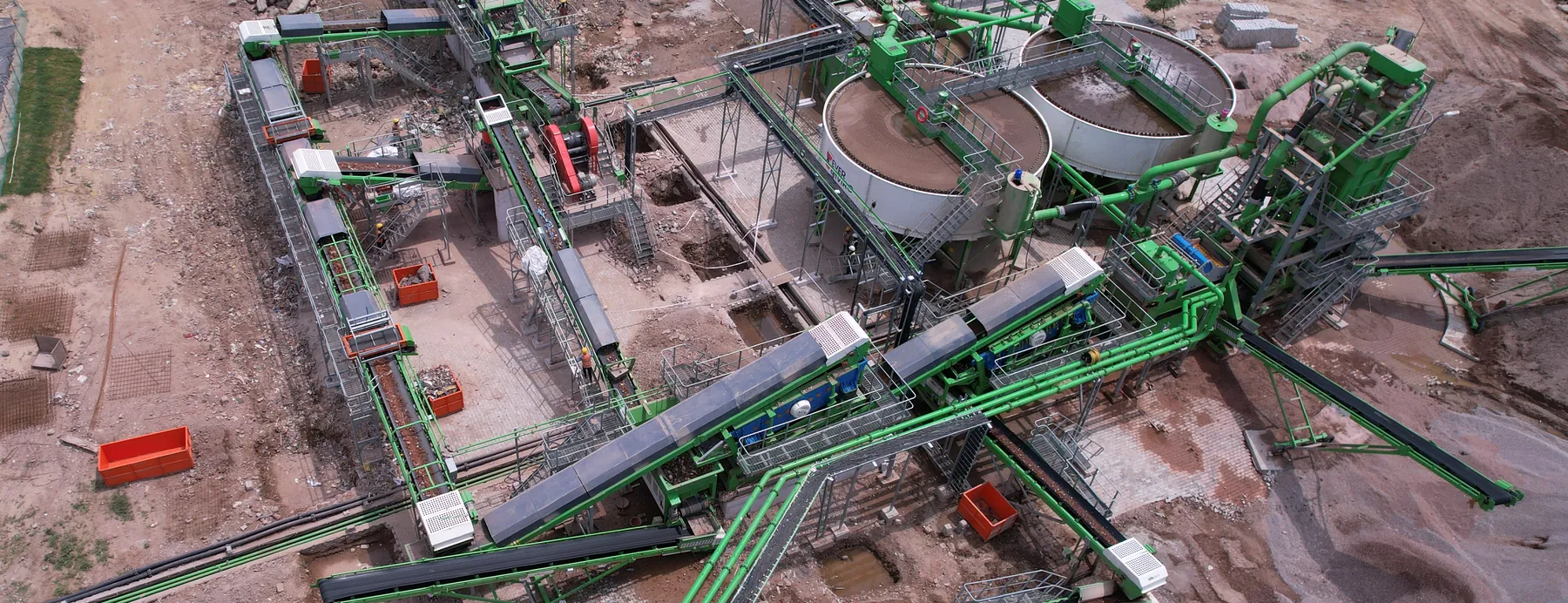
The Reurban is a modular wet processing plant that washes construction and demolition waste, excavation spoil, incinerated bottom ash and clay-bound quarry by-product into washed recycled sand and graded aggregate. Scrubbing and trash removal take out wood, plastics and contaminants first, and up to 95% of the process water is recycled. In the United Kingdom it is supplied and supported by CFlo Europe Limited in Belfast.
The problem with dry-crushed recycled aggregate
Britain already recycles a great deal of its construction and demolition waste, but most of it is crushed and screened dry, and that puts a ceiling on what it can be sold as. Dry processing leaves the clay, the gypsum, the wood and the plastics distributed through the product, so the material ends up as fill and sub-base rather than as an aggregate a concrete plant will take.
Washing is what moves it up. Scrubbing separates the contamination from the stone rather than simply reducing everything in size, trash removal lifts out the light fraction, and the result is graded recycled aggregate and a recycled sand that has a specification rather than a description.
The feeds this plant is bought for
Construction and demolition waste is the core duty. The same circuit also handles excavation and tunnelling spoil, contaminated soils, incinerated bottom ash from energy from waste plants, waste glass, waste foundry sand, and clay-bound quarry by-product where the clay is bonded to the stone and has to be scrubbed off before anything can be graded.
In Britain, most washed recycled aggregate is produced from soils and excavation arisings rather than from demolition rubble. The plant is specified for both.
Each plant is built for its feedstock, so the scrubbing intensity, the number of wash stages and the cut points follow the material you actually receive rather than a standard arrangement.
Where the UK regulatory pressure is
Two things push this in Britain. Landfill tax makes disposal the expensive option, and the quality protocols that let recycled aggregate cease to be waste require the material to meet a specification and be produced under a factory production control regime. A washed product with a controlled grading is far easier to evidence against that than a dry-screened one.
The second is simple availability. As with sand and gravel, new mineral permissions are slow, and a recycled aggregate produced in the city where the demolition happened does not need hauling in from a quarry. That is where the economics usually settle in the United Kingdom, and it is why the plants are built to be moved.
In situ, because the material is heavy
The Reurban is modular and designed to process where the waste arises. Moving demolition arisings twice, once to a distant facility and once back as aggregate, is the largest avoidable cost on the job. Processing on or near the site removes one of those movements.
Plants ship in containers, are factory assembled and tested, and commission in days rather than being built up on site.
Water and the sludge nobody plans for
Up to 95% of the process water is recycled. The material this plant handles produces a fine, sticky sludge, and it is usually the part of a recycling scheme that is underestimated: the Easysettle sludge bay manager rigidifies tailings at the point of disposal so water releases immediately and the lagoon footprint stays small. Mechanical dewatering can be specified where there is no room for lagoons at all.
What is already running, and where
There is no United Kingdom installation yet. The plants below are on three continents, and each one is documented in a published case study.
India's largest. The plant EverEnviro operates at Burari in Delhi is the largest construction and demolition waste processing plant in the country. CFlo C&D plants run across seven Indian cities and together process more than 10,000 tonnes of demolition waste a day.
Qatar. Rawdat Rashed near Doha is the GCC's largest C&D recycling operation, 310 tonnes per hour across two phases, recycling 95% of its water and delivering under 3% fines in the finished aggregate. Fines content is what a BS EN certificate reports, and it decides whether recycled material sells as graded aggregate or only as fill.
Remediation, not only recycling. At a former factory site at Kodaikanal in Tamil Nadu, the Reurban has treated roughly 26,000 tonnes of mercury-contaminated soil for Hindustan Unilever Limited, washing the pollutants out so the cleaned soil fractions could be reused rather than landfilled, with 95% of the process water recycled. It was India's first full-scale industrial hazardous waste site remediation. For a British reader the relevance is legacy industrial land: the duty is the same one a brownfield scheme faces, and it was carried out to a standard a multinational and its regulator would accept.
Canada. A Reurban recycling operation is running in Canada. Its details are not yet released, and we can discuss it under an NDA.
Who you deal with in the UK
A recycling scheme is judged on whether the plant keeps running on a difficult feed, which makes support the first question rather than the last. CFlo Europe Limited handles the UK and Europe from Belfast, and Aggregates Business reported on the expansion and the partner-led model in August 2026.
CFlo is a Net Zero Value Chain Partner of the Global Cement and Concrete Association, the London headquartered body behind the industry's 2050 net zero roadmap. Recycled aggregate is one of the levers in that roadmap, so the framework a UK producer is judged against is the one this plant is built to serve.
A career spent building wet processing plant for quarries in Britain and Ireland, having previously helped build a global wet processing brand.
The words used on both sides of this trade
British and Indian practice use different terms for the same material, and specifications use different terms again. These are the ones that matter when reading a quotation or a test certificate.
Demolition arisings is the material a demolition produces, as it comes: concrete, brick, timber, reinforcing bar, soil and rubble in one load. It is the plant's feed before anything is taken out.
Recycled aggregate, RA, is aggregate recovered from construction and demolition waste and reprocessed for reuse. Recycled concrete aggregate, RCA, is the narrower case where the feed is predominantly old concrete, which grades and performs more predictably.
Secondary aggregate is a by-product of another industry used as aggregate, such as slag from steel making or ash from incineration. It is distinct from recycled aggregate, which was aggregate before, and the two are treated separately in specifications.
Incinerated bottom ash aggregate, IBAA, is the graded product made from the ash left after municipal waste is burned for energy. It needs washing to remove salts and residual metals before it behaves like an aggregate.
Scalping is removing the oversize and the trash from the feed before it reaches the wash plant. Skipping it is the most common reason a recycling plant spends its day clearing blockages.
Attrition scrubbing is rubbing the particles against each other under pressure so adhered clay, mortar and contamination separate from the stone. It is what distinguishes washing from crushing, which only reduces size.
Trash removal is lifting the light fraction, timber, plastic, paper and foam, out of the wet stream. On demolition feed it is not optional.
Fines is the material below the sand sizes. The fraction that governs a concrete specification is the minus 63 micron, which UK certificates report as fines content and Indian practice often calls ultrafines.
Sub-base and capping are the unbound layers beneath a road surface, specified in Britain to BS EN 13242. They are where unwashed recycled aggregate usually ends up, and the grade a washed product is trying to beat.
Factory production control, FPC, is the documented regime under which a producer shows its output consistently meets a specification. It is the practical hurdle for selling recycled aggregate as a product rather than as waste, and a controlled washed grading is far easier to evidence than a dry screened one.
End of waste, abbreviated EoW, is the point at which processed material legally stops being waste and becomes a product, subject to meeting a specification and the control regime above. In Ireland the term is used for the permitted sites themselves, and there are still only a handful of them, which is why washed recycled aggregate has barely started there.
Soil and excavation-waste washing is the duty that produces most of Britain's washed recycled aggregate, ahead of demolition rubble by tonnage.
WATA, the Washed Aggregates Trade Association, is the UK body representing producers of washed aggregate, and the source most often quoted on how much recycled material is washed rather than dry screened.
Replenishment rate is the share of the aggregate a country consumes that is replaced by newly permitted reserves. It is the number behind the whole argument for washing: Great Britain has been replacing about 61% of the sand and gravel it uses and about 33% of the crushed rock, on the Mineral Products Association's figures for 2014 to 2023.
Tailings is the fine waste slurry the wash plant produces. A lagoon is the settling pond it is pumped to, and dewatering is removing water from it mechanically instead, where there is no room for a lagoon.
Sizing it, and who supports it
Sizing starts with a sample, because the contamination and the clay content decide the configuration more than the tonnage does. Material is piloted at our material testing lab before a plant is quoted. The lab is DSIR-accredited and runs pilot units on bulk samples, and the recycled sand is tested in concrete and in brick, so the result covers the product and not only the process.
Pre-Engineering then produces the full engineering package while permits and planning are in progress: process flow, mass balance, layout and equipment schedule, built around the contamination your feed actually carries. Manufacture starts on confirmation rather than from a blank sheet.
Plants carry CE marking for Europe, UKCA for the United Kingdom and CSA for North America, which is what allows the same plant to be shipped to a Canadian site and a Yorkshire one. In the United Kingdom they are sold, installed and supported by CFlo Europe Limited in Belfast. We will be at Hillhead 2026.
Send us a sample
Tell us about the material and an engineer will come back with how much to send, how to sample it, and what the programme would cover.
Frequently asked questions
What does washing achieve that dry crushing and screening does not?
It separates the contamination from the stone instead of reducing everything in size together. Scrubbing removes clay and adhered fines, trash removal lifts out wood and plastics, and classifying controls the grading. The product moves from fill and sub-base towards a graded recycled aggregate and a recycled sand with a specification.
Can the Reurban handle soils and excavation spoil as well as rubble?
Yes. Excavation and tunnelling spoil, contaminated soils, incinerated bottom ash, waste glass, waste foundry sand and clay-bound quarry by-product all run through the same wet circuit. The plant is configured for the feed it will actually see, which is why sizing follows a sample.
Does the recycled product meet a specification?
A controlled grading and the removal of contamination is what makes a recycled aggregate straightforward to evidence against a specification and a factory production control regime. Which specification a given feed reaches depends on what is in it, which testwork establishes rather than a general claim.
Do you have a UK installation we can visit?
Not in the United Kingdom yet. Elsewhere there is EverEnviro at Burari in Delhi, India's largest construction and demolition waste processing plant, and QPMC at Rawdat Rashed in Qatar running at 310 tonnes per hour for a public materials company, which is the nearest thing in the list to a UK municipal scheme. A Reurban recycling operation is also running in Canada, and we can discuss that one under an NDA while its details are unreleased. For your own site the more useful step is a pilot on your feed, which we can run at our material testing lab.
How much water does it use?
Up to 95% of the process water is recycled. Tailings are handled by the Easysettle sludge bay manager, which releases water from the slurry at the point of disposal so lagoons dry faster and take less land. Where there is no room for lagoons, mechanical dewatering can be specified.
Who supplies and supports the Reurban in the UK?
CFlo Europe Limited, based in Belfast, handles UK and European sales, installation and technical support. Plants carry CE marking for Europe, UKCA for the United Kingdom and CSA for North America. Call +44 78687 88960 or email [email protected], and we will be at Hillhead 2026.