India's EPR Mandate: The End of C&D Waste Dumping
12 May 2026
A regulatory reset that took effect on 1 April 2026 has done what two decades of policy could not. It has made construction and demolition waste expensive to ignore. The implications travel further than India's city limits, and reach into a fast-growing construction industry that is running out of sand.
The world has a sand problem. Global construction now consumes approximately 50 billion tonnes of sand and aggregate every year, against a natural replenishment rate of 15 to 20 billion tonnes. Every brick, every beam, every bridge deck and every metro tunnel need sand of a specific kind, angular, well graded, free of salt. Desert sand will not bond with cement; its grains are too smooth. Sea sand corrodes steel reinforcement through residual chloride. River sand, the construction industry's traditional source, is being extracted faster than the rivers can rebuild it, with consequences that range from drained aquifers to collapsing riverbanks.
India sits at the centre of this equation. It is one of the largest consumers of construction sand in the world, and one of the worst recyclers of construction waste. The country generates somewhere between 150 and 500 million tonnes of construction and demolition (C&D) waste each year. Estimates vary because measurement was never systematic. What is not in dispute is the recovery rate. Less than one per cent of this material has historically been recycled. By comparison, the United States recovers approximately 70 per cent of its C&D waste, the United Kingdom around 90 per cent, and Europe roughly 55 per cent. The gap is not technological but structural.
That structure has now been redrawn.
An Architecture, Built like Layers of Waste
India's policy response to construction waste has not been absent. It has been massively incomplete. The Construction and Demolition Waste Management Rules of 2016 made recycling mandatory in principle and defined responsibilities. The Sand Mining Framework of the same year curbed illegal extraction and pushed alternatives such as manufactured sand and coal-waste sand. Swachh Bharat Mission 2.0 directed 154 cities to establish C&D recycling capacity. Each of these was a layer and none was a complete structure.
What was missing was the one feature that converts policy intent into commercial behaviour, accountability with measurable consequences.
The Environment (Construction and Demolition) Waste Management Rules, 2025, effective from 1 April 2026, supply that missing piece. The mechanism is Extended Producer Responsibility, or EPR, applied for the first time to building rubble. Any developer, builder or project in-charge with a built-up area of 20,000 square metres or more must now register on a centralised Central Pollution Control Board portal and meet mandatory recycling and utilisation targets. Non-compliance triggers environmental compensation penalties. Local authorities must integrate waste management plans into project approvals, making compliance a condition of construction rather than an afterthought.
The recycling targets escalate sharply. 25 per cent in 2025-26, 50 per cent the following year, 75 per cent in 2027-28, and full circularity from 2028-29 onwards. In three building seasons, complete recycling becomes the legal baseline rather than a policy aspiration.
The more consequential provision is on the demand side. Recycled C&D material must now be incorporated into new construction. The minimum recycled content begins at 5 per cent in 2026-27 and rises to 25 per cent by 2030-31 for buildings, with a parallel schedule for road projects reaching 15 per cent. For the first time, recycled sand and recycled aggregate are not a marginal alternative to natural inputs. They are a required component of every large construction project in the country.
Why Recycling in India Did Not Scale Before
Recycling infrastructure has historically struggled in India not because the technology was unavailable but because recovered material had no assured market. Builders were reluctant to specify recycled aggregate when they could not be sure a recycler would still be operating in twelve months. Recyclers were reluctant to invest in capacity when their revenue depended entirely on a discretionary buying decision by the developer. The two sides were waiting for each other.
The new rules break this stalemate by mandating offtake. A developer's compliance can no longer be satisfied by sending rubble to a recycler. It requires that recycled material be specified back into new construction or that EPR certificates be purchased from authorised recyclers through a tradeable digital marketplace. The certificate mechanism creates a price signal for verified recycled material, and the CPCB portal monitors waste generation, movement and recycling in real time. Disposal-by-paperwork, the structural enabler of the informal disposal economy, is now traceable.
Where Policy Meets Engineering
Mandates create demand but they do not automatically create processing capability. Converting mixed C&D waste into construction-grade sand and aggregate is not a matter of crushing and screening. The input is heterogeneous. The output specification is not.
A typical urban C&D feed contains adhered cement on broken aggregate, contaminating clay and silt, brick fines, soil, glass, gypsum, plastic, wood, metal and the variable moisture content that comes with open storage. Lightweight contaminants reduce product value. High fines content lowers workability and raises the water-cement ratio in any concrete made from it. Adhering cement on aggregate produces lower compressive strength. Each of these is a measurable defect, and each is what separates a sorting yard from a recycling facility.
To produce sand and aggregate that meet IS 383:2016 specifications, with the consistency a builder will trust against fresh quarry material, the feed must be scrubbed and made free of light-weight contaminants, classified by size, washed of fine clay, dewatered to a controlled moisture and stockpiled by product fraction. Each of those steps involves a wet process. A modern wet processing plant achieves 95 to 100 per cent conversion of input to useful output, recovers up to 95 per cent of process water with no liquid discharge, holds particulate emissions of PM10 and PM2.5 to safe levels at source, and operates below 80 dB. The dry crushing and screening yards that have served the informal recycling sector cannot meet either the specification or the environmental envelope the regulation requires.
In-Situ: Processing the Waste Where It Is Produced
The question of where C&D waste is processed matters as much as the question of how. The conventional disposal model in Indian cities sends waste leaving the demolition site by truck, travelling through urban traffic to a centralised yard or a dump, and then in the better cases travelling back as recycled product to a different construction site. Each leg of that journey is a cost, in fuel, in road congestion, in fugitive dust at loading and unloading points, in vehicular emissions and in the multiple handling that itself generates further fines and contamination.
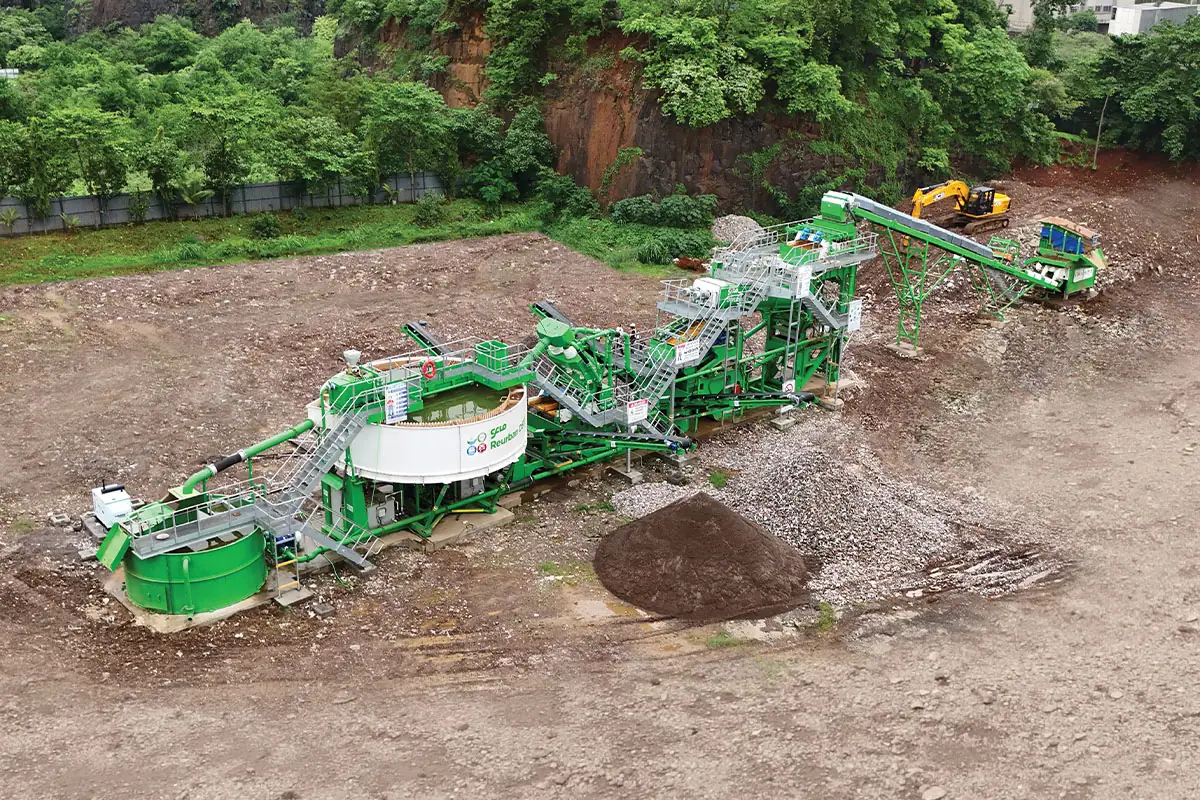
A modular wet processing plant designed for in-situ deployment shrinks this loop to its minimum. The waste is processed where it falls. The output, classified into sand, multiple aggregate fractions and screened soil, is either used directly on the same site or moves only once, to a known offtake. Air quality at the work face improves because wet processing keeps PM10 and PM2.5 within safe levels at source. Water consumption is contained because the system reuses processed water in a closed loop. The plant footprint scales to the project requirement: compact 50 to 100 tonne-per-day configurations fit inside large brownfield redevelopment sites, mid-range 200 to 500 tonne-per-hour systems serve small-city processing needs, and dedicated 1000-2000 tonne-per-day configurations work directly on large scale recycling sites in cities like Delhi, Mumbai etc.
The biomining configuration is the most consequential for India's accumulated waste problem. The Reurban Hunter, engineered for the recovery of legacy waste, processes trommel fines into a single sand product on the dumpsite itself, supported by integrated prescreening. The entire site, freed of its inert waste burden, becomes available for reuse. The pattern is already established. Indore's bioremediation programme cleared a 100-acre legacy dumpsite of 1.3 million tonnes and now houses C&D recycling capacity on the same ground that was previously the problem. Delhi's Burari plant reclaimed approximately 45 acres of land that had been buried under legacy debris. The land recovered by these projects, in cities where development land trades in hundreds of crores per acre, is itself a return that justifies the processing economics.
What "Recycled" Actually Becomes
The economic case for circularity rests on what the recycled material is actually worth. Across CFlo's installed plants in India, a typical urban C&D feed yields approximately 50 per cent sand, 28 per cent aggregate and 18 per cent screened soil, with the balance accounted for as light fraction trash, fines and process losses. Each fraction has a defined market and a defined regulatory pathway.
Recycled Concrete Aggregate (RCA) is permitted under IS 383:2016 for use up to 25 per cent in plain concrete, up to 20 per cent in reinforced concrete of grade M25 and below, and up to 100 per cent in reinforced concrete of grades below M15. It moves into precast products, civil maintenance work and concrete up to M25. Independent testing by the Sardar Vallabhbhai National Institute of Technology has confirmed compressive strength of 50 N/mm² in concrete made from 100 per cent recycled aggregate produced at the Surat plant. Recycled Aggregate (RA) is permissible up to 100 per cent in reinforced concrete below M15 grade and is used in road sub-base, low bearing concrete blocks and lean concrete.
Recycled sand moves into brickwork, mortar, concrete road construction, paver blocks, bricks, tiles and concrete blocks. Screened soil is specified for gardening, embankment fill, land filling, and as filler particle in granular sub-base (GSB) and wet mix macadam (WMM) layers in road construction.
Beyond commodity outputs, the same processed material moves into a value-added product range that includes paver blocks, kerb stones, tiles, jalli, concrete blocks, wall cladding, bollards, planters, fence posts, park benches, precast compound walls and drain covers. Perforated thermo sustainable bricks, designed as facing bricks for visible facades, are produced directly from recycled aggregate. Unburnt bricks made from recycled fines do not require kiln firing, eliminating both the energy and the emissions associated with conventional brick production. Each of these end products has a price point above the commodity sand and aggregate it competes with, and each routes a different fraction of the recovered material into a market that values it on its merits.
The regulatory mandate forces offtake. Only specification-grade output, classified into the right products at the right grades, sustains the price structure that makes recycling commercially viable beyond compliance.
A Footprint Built Before the Mandate
The technology to do this work at scale has been operating in India for nearly two decades. CFlo's installed base now spans over 500 projects across 18 countries, processing more than 10,000 tonnes of urban waste every day across its C&D installations alone.
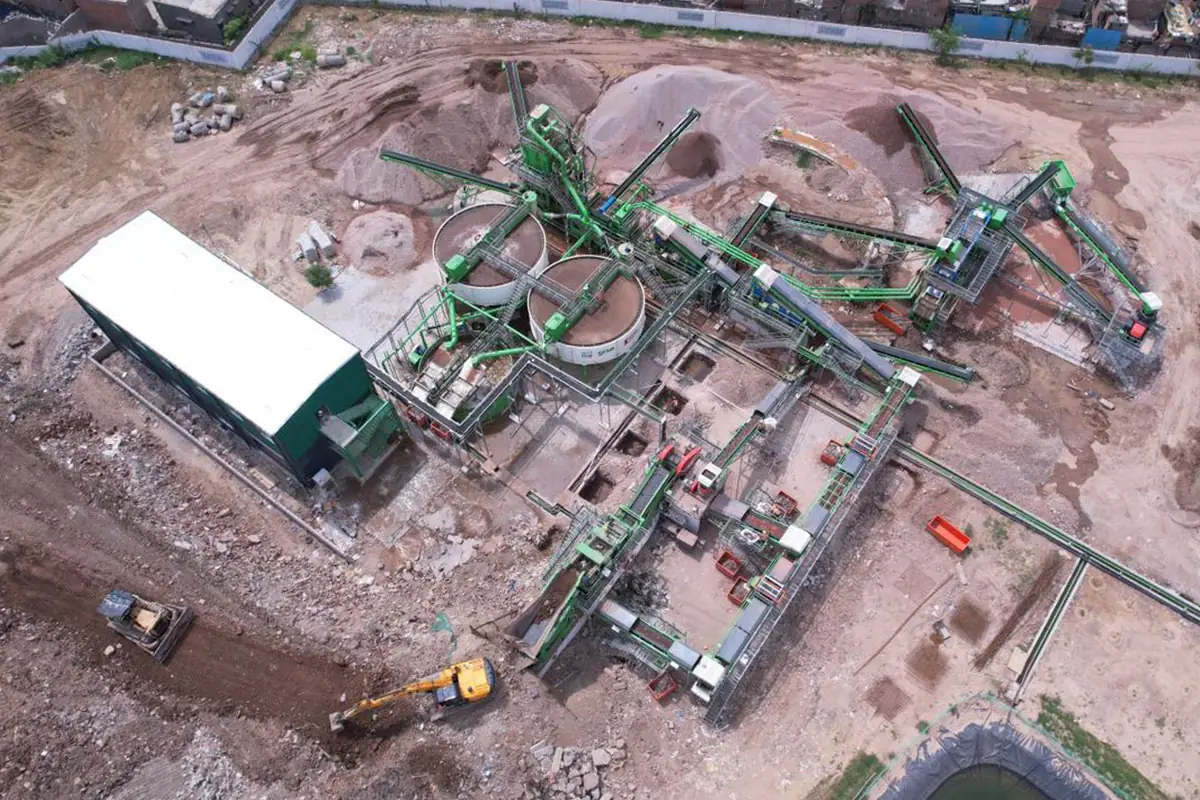
Within India, the network covers the country's largest construction markets. The Burari Construction and Demolition Waste Processing Plant in Delhi, inaugurated in October 2023, is India's largest at 2,000 tonnes per day. Mumbai's first-ever C&D recycling plant, powered by CFlo wet processing technology, transforms 600 tonnes of daily debris into specification-grade input. The Hyderabad facility, the largest plant of its kind in South India, recycles 500 tonnes per day. The Surat plant, processes 300 tonnes per day. The Thane facility handles 300 tonnes of waste, and the Pune installation runs a 200 tonnes per day facility, producing manufactured sand in four grades. Delhi alone hosts three CFlo C&D projects, Mumbai another three and Hyderabad two, with additional installations in Nasik, Aurangabad and Kodaikanal.
These plants were commissioned when there was no EPR mandate, no compulsory utilisation target, no traceability portal and no certificate market. They were built on the engineering case alone, well in advance of the regulatory case catching up. The same modular wet processing platform with customisation now runs across construction waste, incinerated bottom ash, tunnelling spoil, excavation waste, glass cullet, contaminated soil and waste foundry sand. The feedstock changes; the processing logic does not.
The International Read-Across
The question of whether circular construction can scale in a fast-urbanising economy has, until now, been an open one. Wealthy economies have closed their loops with the benefit of slower urban growth, mature waste infrastructure and decades of consumer-funded environmental regulation. India is attempting to close the loop while still building at full pace, with an annual construction order book unlike anything in the developed world.
If the EPR architecture holds, with its combination of producer accountability, mandatory utilisation, digital traceability and tradeable compliance certificates, it will offer a model that is more directly applicable to the Global South than anything imported from west. The economics work because they are forced to. The compliance burden is real, and the compliance route is engineered for the volumes involved.
For international developers, technology providers and institutional investors with a position in Indian infrastructure, two implications follow. The first is that natural sand and quarry aggregate will face a structurally rising cost curve as recycled material captures specified share. The second is that the processing infrastructure needed to supply that recycled share is now a commercial proposition rather than an environmental one. The window in which recycled aggregate was a niche product priced as a sustainability premium is closing. It is becoming a mainstream input, priced as one. Other large urbanising economies, from Indonesia and Vietnam to Egypt and Nigeria, will read the Indian implementation closely, and the operational track record being built across Indian cities now will be the reference base when those policies arrive.
The Question Is No Longer Whether
A regulatory reset of this kind does not produce circular outcomes overnight. The informal economy that currently moves a significant share of India's construction waste will not disappear because a portal exists. Capacity does not arrive on a procurement cycle that matches the recycling escalator from 25 per cent to 100 per cent in three years. There will be shortfalls, contested measurements and legitimate questions about how precisely environmental compensation penalties are enforced.
But the architecture is now in place. The framework, the targets, the offtake mandate, the traceability layer, the price signal and the penalty regime have, between them, created the first complete policy structure for construction waste this country has had. For the first time, the financial logic of dumping is worse than the financial logic of recycling.
The question is no longer whether India's construction waste will be regulated. It is how quickly the processing infrastructure can scale to meet a deadline that is already in effect.
For developers, the registration requirement is immediate. For recyclers, the market signal is unambiguous. For technology providers, the operational track record built before the regulation arrived is now an asset. And for the rest of the world, watching a market the size of India's begin to close its construction loop, the read-across is hard to miss.
The era of the dump is ending. What replaces it is being built, and rebuilt, on the same ground.